
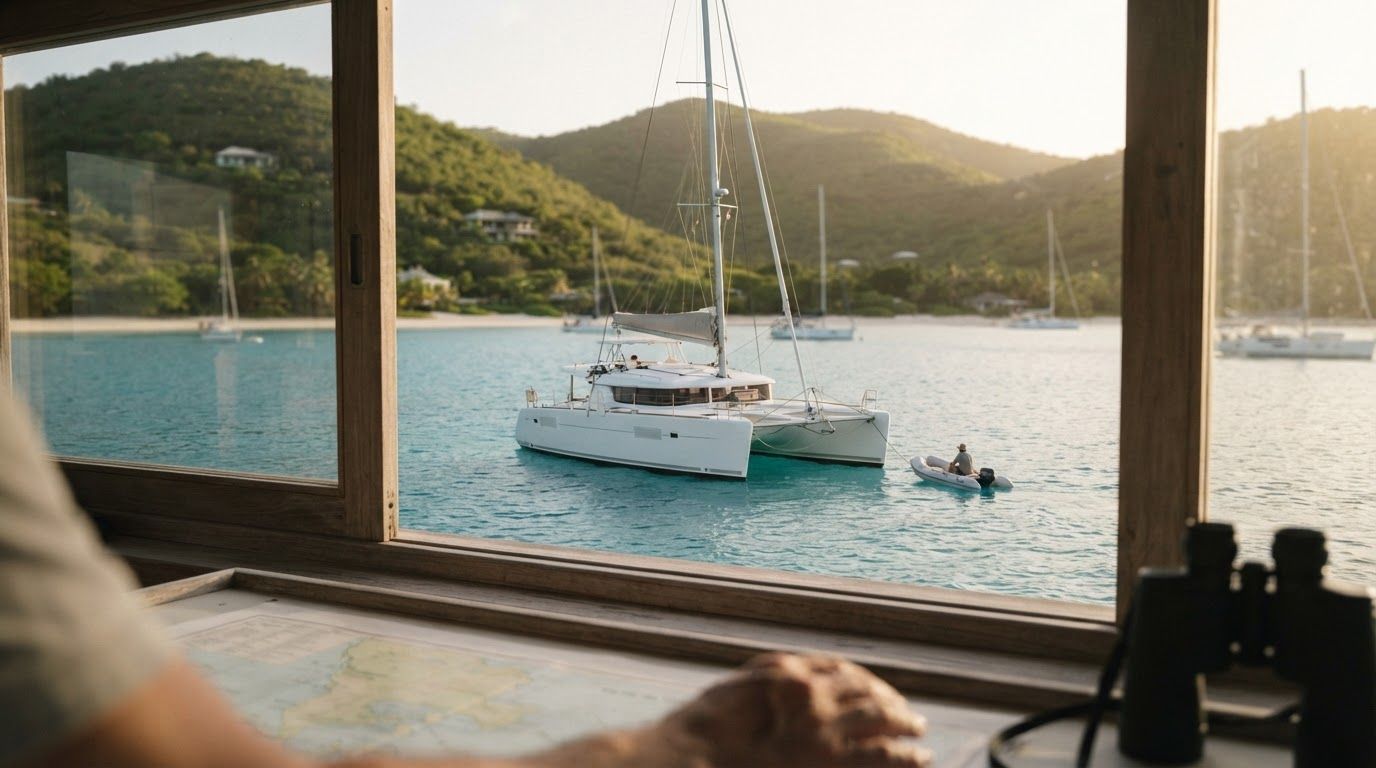
Catamarans · Size Guide
A 45 foot catamaran is big enough to live aboard and host two other couples, yet small enough for two people to sail, dock and haul out without a professional crew. That balance is why the size dominates Caribbean cruising and the charter fleets that feed the used market.
Ask a room full of Caribbean cruisers what size catamaran they would buy again and a surprising number land within a couple of feet of 45. Builders know it, which is why the Leopard 45, the Lagoon 450 and the Fountaine Pajot Elba 45 have all been central models in their ranges. Charter companies know it too, and their fleets turn over into the brokerage market every few years.
This guide sets out what you actually get at 45 feet: the dimensions, the cabin layouts, the yards that can lift one, what new and used boats sell for, and how the size compares with 40 and 50 feet. Every specification below comes from a published source so you can check it before you shortlist a boat.
Key Takeaways
- 01
A 45-foot cruising catamaran typically carries 24 to 26 ft of beam, about 4 to 5 ft of draft and 14 to 15 tonnes of light weight.
- 02
It is the largest size most couples can sail without crew and often the smallest that gives a family their own cabins.
- 03
Owner’s versions trade a guest cabin for a full-hull master suite and tend to carry a resale premium with private buyers.
- 04
Plan haul-outs around a wide-body travel lift; beam, not length, decides which yards can take the boat.
- 05
Recent used Lagoon 450s sit around 450,000 to 700,000 euros, while new boats start near 690,000 euros before options.
45 Feet at a Glance
The three best known 45-foot cruising catamarans are closer in size than their marketing suggests. The Leopard 45 specification sheet lists a 45 ft hull, a 24 ft 2 in beam, a 4 ft 11 in draft and a displacement of 32,849 lb, from a Simonis Voogd design built by Robertson and Caine in South Africa. The Lagoon 450 model data gives 13.96 m (45 ft 10 in) overall, a 7.87 m (25 ft 10 in) beam and a 1.30 m (4 ft 3 in) draft. The Fountaine Pajot Elba 45 figures show 13.45 m (44 ft 1 in), a 7.55 m (24 ft 10 in) beam, a 1.2 m (3 ft 11 in) draft and about 14 tonnes unloaded.
Three benchmark 45-foot cruising catamarans
Good Old Boat; Yachting Address; The Catamaran Gurus
| Model | Length overall | Beam | Draft | Weight | Cabin options |
|---|---|---|---|---|---|
| Leopard 45 | 45 ft 0 in | 24 ft 2 in | 4 ft 11 in | 32,849 lb | 3-cabin owner’s or 4-cabin |
| Lagoon 450 | 45 ft 10 in | 25 ft 10 in | 4 ft 3 in | about 15 t light | 3-cabin owner’s or 4-cabin |
| Fountaine Pajot Elba 45 | 44 ft 1 in | 24 ft 10 in | 3 ft 11 in | about 14 t unloaded | 3-cabin owner’s or 4-cabin |
Read across the table and a pattern appears. Beam sits between 24 and 26 feet, draft between roughly 4 and 5 feet, and weight between 14 and 15 tonnes. Those numbers drive almost every practical question an owner faces, from which anchorages you can reach to what a marina charges you. How each builder shapes the hulls and the space between them matters as much as the headline length, and our explainer on bridgedeck and daggerboard design covers what those differences mean once you are at sea.
Why 45 Feet Is the Caribbean Sweet Spot
The Caribbean rewards a boat that handles steady trade winds of 15 to 25 knots, short open crossings between islands and long stretches at anchor. A 45-footer sits in the middle of that brief. It has enough waterline to carry a full cruising load of water, fuel, dinghy and provisions without dragging its transoms, and enough hull length to ride the short, steep seas of channels like the Anegada Passage more comfortably than a 38 or 40.
At the same time, the loads stay human. Sail areas, anchor weights and winch loads on a 45 are within what a fit couple can manage with electric winches and good technique. Push to 50 feet and beyond and many owners start to rely on powered everything, a larger crew or a paid captain for deliveries. Our piece on the reasons owners love catamarans explains why stability and living space draw buyers to two hulls in the first place; 45 feet is where those benefits arrive without the big-boat overheads.
01 · Handling
Two people can sail it
Lines lead to a helm station, twin engines give tight-quarters control, and sail loads stay manageable. A couple can make island hops of 20 to 40 miles without extra crew.
02 · Volume
Room for real living
Three or four double cabins, a galley that two can cook in, and a cockpit big enough for six at dinner. Full-time liveaboards rarely feel cramped at this length.
03 · Market
Deep resale pool
Because charter fleets buy heavily in this band, there are always used boats for sale and always buyers for a well-kept one. Liquidity protects your exit price.
40 vs 45 vs 50 Feet
Most buyers do not agonise over whether to buy a catamaran; they agonise over how big. The jump from 40 to 45 feet usually adds a usable fourth cabin or a far larger owner’s suite, more tankage and noticeably better motion in a seaway. The jump from 45 to 50 adds more of the same, but the bills scale too: dockage, haul-outs, antifouling, insurance and rigging replacement are all priced by length, beam or value.
40 to 42 feet
- ✓Lower purchase price and running costs
- ✓Easier to find a slip or a haul-out slot
- ✗Tighter tankage limits time between fuel and water stops
- ✗Guest cabins feel small for long stays
48 to 50 feet
- ✓More cabin, saloon and storage volume
- ✓Smoother ride in open-water passages
- ✗Higher dockage, insurance and maintenance per year
- ✗Heavier loads push owners toward crew or captains
The 45-foot band sits between those columns. For a couple who host family a few weeks a year, it is usually the most boat you can still run alone. For a family of four or five living aboard, it is often the smallest size that gives everyone their own cabin. Our guide to the best catamarans for liveaboard life compares specific models if you are choosing on comfort rather than on length alone.
Berthing, Draft and Haul-Out at This Size
Beam, not length, is what limits a catamaran in a marina or boatyard. With 24 to 26 feet of beam, a 45-footer usually needs an end tie or a double-width slip, and some marinas charge multihulls a premium over monohulls of the same length. Before you buy, compare the dockage rates by length in the islands you plan to base the boat, because the difference between a mooring and a marina berth can exceed the annual insurance premium.
Draft is the good news. At roughly 4 to 5 feet, a 45-foot catamaran reaches anchorages that turn deeper monohulls away, and it can tuck close to shore in places like the North Sound of Virgin Gorda or the shallow bays of Anegada with careful navigation. Fixed keels also let most of these boats take the ground on a beach or a careening grid in an emergency, something few monohulls of the same length can do safely.
Haul-out capacity is the constraint new owners forget. A standard travel lift is too narrow for a 25-foot beam, so you need a wide-body machine. In Tortola, the Nanny Cay boatyard runs a wide-body 70-tonne Travelift rated for catamarans up to 32 feet of beam and 70 tons, which handles every 45-footer in the table above with room to spare. Ask any yard you plan to use for its lift width and its multihull storage space before the boat needs bottom paint or hurricane storage.
- Typical beam
- 24 to 26 ft: plan for an end tie, double slip or mooring
- Typical draft
- About 4 to 5 ft with fixed keels
- Typical weight
- 14 to 15 t light, more when fully loaded for cruising
- Lift needed
- Wide-body travel lift; check the beam rating, not just the tonnage
- Storm season
- Book a cradle or tie-down slot early; wide boats fill yards fast
Owner's Version vs Four-Cabin Charter Layout
Every model in this size is sold in at least two layouts. The owner’s version gives one entire hull to a master cabin, usually with a large head and shower forward, a desk or settee midships and plenty of storage, and splits the other hull into two guest cabins. The four-cabin version puts a double cabin at each corner of the boat, each with its own head, which is what charter companies order because it lets them sell the boat to four couples.
That difference matters most when you buy ex-charter. Most used 45-footers on the Caribbean market came out of a fleet, so the four-cabin layout is the one you will see most often. It is not a bad boat to own: four heads make life easy with guests, and the extra cabin can become a workshop or storage room. But a three-cabin owner’s version usually commands a premium at resale among private buyers, and a four-cabin boat that has run several charter seasons needs a thorough survey of its heads, pumps, air conditioning and soft furnishings.
Ex-charter buyers
Read the fleet history before the survey
Ask for the charter maintenance logs, the number of seasons in service and any insurance claims. A boat that left the fleet on schedule with documented servicing is often a better buy than a lightly used private boat with no records.
If you are thinking about the other direction, buying a new or nearly new boat and placing it in a fleet to offset costs, read our guide to charter-managed yacht ownership first. The four-cabin layout is almost always the condition of entry, and the management contract decides how much time you can actually spend aboard.
What They Cost New and Used
New boats in this size are priced in euros at the factory and climb quickly with options. The Elba 45 base price listed by The Catamaran Gurus starts at around 686,700 euros, before electronics, a generator, watermaker, solar and the shipping or delivery that a Caribbean buyer needs. Fully equipped, a new 45-foot catamaran commonly lands well above the base figure once it is commissioned in the islands.
Used prices spread widely by age, layout and charter history. Yachting Address puts recent used Lagoon 450s at roughly 450,000 to 700,000 euros, with older Lagoon 440s and early Leopard 4-series boats below that range. For a fuller breakdown of new, used and ex-charter prices across all sizes, and how condition shifts value within a single model, see our catamaran cost guide.
€686,700
Elba 45 base price before options
The Catamaran Gurus
€450k–700k
typical range for recent used Lagoon 450s
Yachting Address
32 ft
maximum catamaran beam on Nanny Cay's wide-body lift
Nanny Cay
Purchase price is only the start. Budget each year for insurance, which in the Caribbean is shaped by named-storm cover, plus dockage or moorings, a haul-out with antifouling every one to two years, and engine and saildrive servicing on two of everything. Standing rigging is commonly replaced every 10 to 15 years, and sails and trampolines wear faster under tropical sun. Factor those into your offer, not just the asking price.
How to Choose the Right 45-Footer
STEP 01Decide who sleeps aboard
Count the people who will be aboard on a normal week, not the busiest week. A couple with occasional guests is usually happiest in an owner’s version; a family or a charter plan points to four cabins.
STEP 02Set your sailing radius
If you will stay inside the Virgin Islands, tankage and passage speed matter less than shade and cockpit space. If you plan to head south to Grenada or across to the Bahamas, prioritise tankage, a watermaker and solar.
STEP 03Check the age of the big-ticket items
Engines, saildrives, rigging, sails and the generator are the expensive replacements. A cheaper boat that needs all of them can cost more than a dearer one that does not.
STEP 04Plan where the boat lives
Confirm a slip or mooring and a wide-body haul-out yard before you close. In hurricane season, availability is limited and the beam of a catamaran narrows your choices.
STEP 05Survey and sea trial
Use an accredited marine surveyor familiar with multihulls, and sea trial in real trade-wind conditions. Check bridgedeck slamming, engine temperatures under load and every through-hull fitting.
For most cruising couples, 45 feet is the largest catamaran they can still run without crew, and the smallest that gives every guest a door to close.
BVI Yacht SalesWhen you are ready to compare real boats, start with the yachts for sale in the Caribbean and filter by length. Because BVI Yacht Sales works on a co-brokerage basis, a broker can also show you suitable 45-footers listed by other firms, so your shortlist is not limited to one office’s listings.
QHow many people can a 45-foot catamaran sleep?
A four-cabin layout sleeps eight in double berths, and many models add one or two extra berths in the saloon or forepeak crew cabins. A three-cabin owner’s version sleeps six comfortably. For long stays, plan on two fewer people than the maximum berth count.
QWhat does a 45-foot catamaran cost?
New boats start at roughly 690,000 euros for the base model and rise substantially once electronics, power systems and delivery to the Caribbean are added. Recent used Lagoon 450s typically sell between about 450,000 and 700,000 euros, and older or high-hour ex-charter boats go for less.
QCan a couple handle a 45-foot catamaran alone?
Yes. Most modern 45-footers lead lines to the helm, use electric winches and have twin engines for docking, so a competent couple can sail and berth them without extra crew. The key skills are reefing early in the trade winds and planning docking in a crosswind.
QWhat draft does a 45ft catamaran have?
Usually between about 4 and 5 feet with fixed keels. The Elba 45 draws about 3 ft 11 in, the Lagoon 450 about 4 ft 3 in and the Leopard 45 about 4 ft 11 in, which opens many shallow Caribbean anchorages.
QWhat does a 45ft slip cost in the Caribbean?
It varies widely by island and by season, and many marinas charge catamarans extra for their beam or require an end tie. Get written quotes for the specific marina and season, and compare them with the cost of a mooring, which is often much lower.
QIs 45 feet big enough to live aboard?
For most couples and many families, yes. A 45-footer carries enough water, fuel and storage for long stays at anchor, and the bridgedeck saloon and cockpit give genuine living space. Liveaboards usually add solar, a watermaker and extra battery capacity to stay off the dock.
Talk to a broker
Looking for the right 45-foot catamaran?
BVI Yacht Sales has broker offices in Tortola, St. Croix and Annapolis. Tell a broker how you plan to use the boat and get help comparing layouts, history and price.
Featured Listings
$599,000
$1,300,000
$1,699,000

$299,000

$899,000
$1,795,000

$269,000
$359,000
$499,500
$299,500
$1,290,000
$800,000
$545,000
$564,900
$1,130,000
$159,000
$499,000
$89,000
$89,000
$135,000
$98,250
$149,850
$369,000
$395,000
$349,000
$125,000
$1,724,571
$149,500
$109,900
$395,000

$652,000
$105,000

$115,000
$950,000
$149,000
$135,000
$349,000