
Buying Guide · Ownership Paperwork
Yes, you can often buy a boat without a state title, because many cruising yachts were never titled in the first place. What you cannot safely buy is a boat whose ownership, liens and registration history nobody can prove.
Key Takeaways
- 01
A missing state title is normal for documented yachts and foreign-flagged boats; what matters is a provable chain of ownership.
- 02
Order the USCG abstract of title or the registry transcript yourself before you pay for a survey.
- 03
Maritime liens follow the hull and are often unrecorded, so lien protection has to come from the contract and the closing.
- 04
Walk away from a hull number mismatch, a dissolved owning company, an unreleased mortgage or a seller with no chain of sale.
The Short Answer: Legal, Sometimes. Safe, Rarely
Buying a boat without a title is legal in many situations. Plenty of states do not title small boats at all, larger yachts are usually documented with the US Coast Guard instead of titled, and boats registered in the British Virgin Islands or another flag state carry a registry certificate rather than a title. In each of those cases the missing title is normal, and the real question is whether some other record proves the seller owns the boat outright.
Where buyers get hurt is the other case: a boat that should have a title or a registration record and does not, sold by someone who cannot show how the boat came into their hands. That is when a missing title stops being a paperwork gap and becomes a sign that the seller may not have the right to sell, that a lender still has a claim, or that the hull is not the boat the listing describes.
Definition
Proof of ownership — The set of records that, taken together, show an unbroken chain from the builder to the current seller: a title, a Certificate of Documentation or a foreign registry certificate, plus the bills of sale that connect each owner to the next and a clean record of mortgages and liens.
Titles, Registrations and Documentation Are Three Different Things
Most of the advice that ranks for this question was written for a 17-foot runabout on a trailer. It treats every boat as if it lives in one state’s motor vehicle system. Cruising yachts in the Caribbean rarely do. Before you decide whether a missing title matters, work out which of three systems the boat belongs to, because each one proves ownership in a different way. The sell-side of the same paperwork is covered in the guide to yacht title transfer and documentation, which is worth reading alongside this one if you are on both sides of a trade.
State Title
A state title is issued by a state agency, usually the motor vehicle department or a natural resources department, and it works much like a car title. It names the owner, lists any lienholder, and is signed over at sale. Titling rules vary widely from state to state: some title every motorboat, some only boats over a set length or engine size, and some do not title boats at all and rely on a registration card. A state registration number on the bow is not proof of ownership on its own; it shows who registered the boat, not who owns it free and clear.
When a titling state boat has lost its title, most states offer a replacement through the owner of record, and some offer a bonded title process for buyers who cannot reach a prior owner. A bonded title takes time and a surety bond, and it is a fix the seller should complete before closing, not a project the buyer should inherit.
USCG Certificate of Documentation
Larger yachts owned by US citizens are commonly documented with the federal government instead of titled. According to the US Coast Guard National Vessel Documentation Center, a vessel must measure at least five net tons to be documented, and net tonnage is a measure of internal volume, not weight. In practice that captures most cruising sailboats, catamarans and motor yachts from the high twenties in length upward.
Documentation matters to a buyer for two reasons. First, the Coast Guard keeps an abstract of title for every documented vessel: a running history of owners, recorded bills of sale, and any preferred ship mortgage filed against it. You can order a current abstract from the Documentation Center before you sign anything. Second, lenders who finance documented boats record a preferred ship mortgage there, so the abstract is where an unreleased loan shows up. A documented yacht with no state title is completely normal. A documented yacht whose abstract shows a mortgage that the seller says was paid off is a problem until the satisfaction is recorded.
Foreign Flag and Offshore Registries
Much of the Caribbean fleet is not in the US system at all. Boats are flagged in the British Virgin Islands, the UK, or another registry, and many are owned through a company rather than in a person’s name: a charter company, a BVI business company, or a Delaware LLC set up for a US owner. In those cases the registry certificate shows the registered owner, which may be the company, and ownership changes hands either by a bill of sale or by a transfer of the company’s shares.
Each route leaves a different trail. A sale of the boat itself needs a bill of sale from the registered owner and, if the boat is changing flag, a deletion certificate from the old registry before the new one will accept it. A sale of the owning company needs corporate records that show who holds the shares and who is authorized to sign. The registration and flag question also differs between the territories, which is one reason buying a boat in St. Croix and the USVI is not a copy of buying in Tortola.
What Actually Proves Ownership Without a Title
When there is no title, ownership is proven by assembling records that agree with each other. No single paper settles it; the test is whether they tell the same story about the same hull.
Records that prove ownership when there is no title
| Record | What it proves | Where it comes from | Red flag |
|---|---|---|---|
| Builder’s certificate or manufacturer’s statement of origin | Who first owned the hull and its original identity | Builder or first dealer | Missing on a late-model boat, or names a different model year |
| Bill of sale chain | Each transfer from one owner to the next | Every past seller | A gap between owners, or a seller who is not the last buyer named |
| USCG abstract of title | Recorded owners and preferred mortgages on a documented vessel | National Vessel Documentation Center | An unsatisfied mortgage or an owner name that does not match the seller |
| Registry certificate | Registered owner and flag state | BVI or other flag registry | Expired registration or a registered owner that is a company the seller cannot show they control |
| Deletion certificate | The boat has left its previous registry | The old flag state | Absent when the boat is being re-flagged |
| Company resolution and share records | Who may sell a company-owned boat | The owning company’s registered agent | Signer not listed as a director, or the company struck off the register |
| Hull identification number check | The paperwork describes this hull | The transom, the builder and the documents | Number altered, missing or different from the papers |
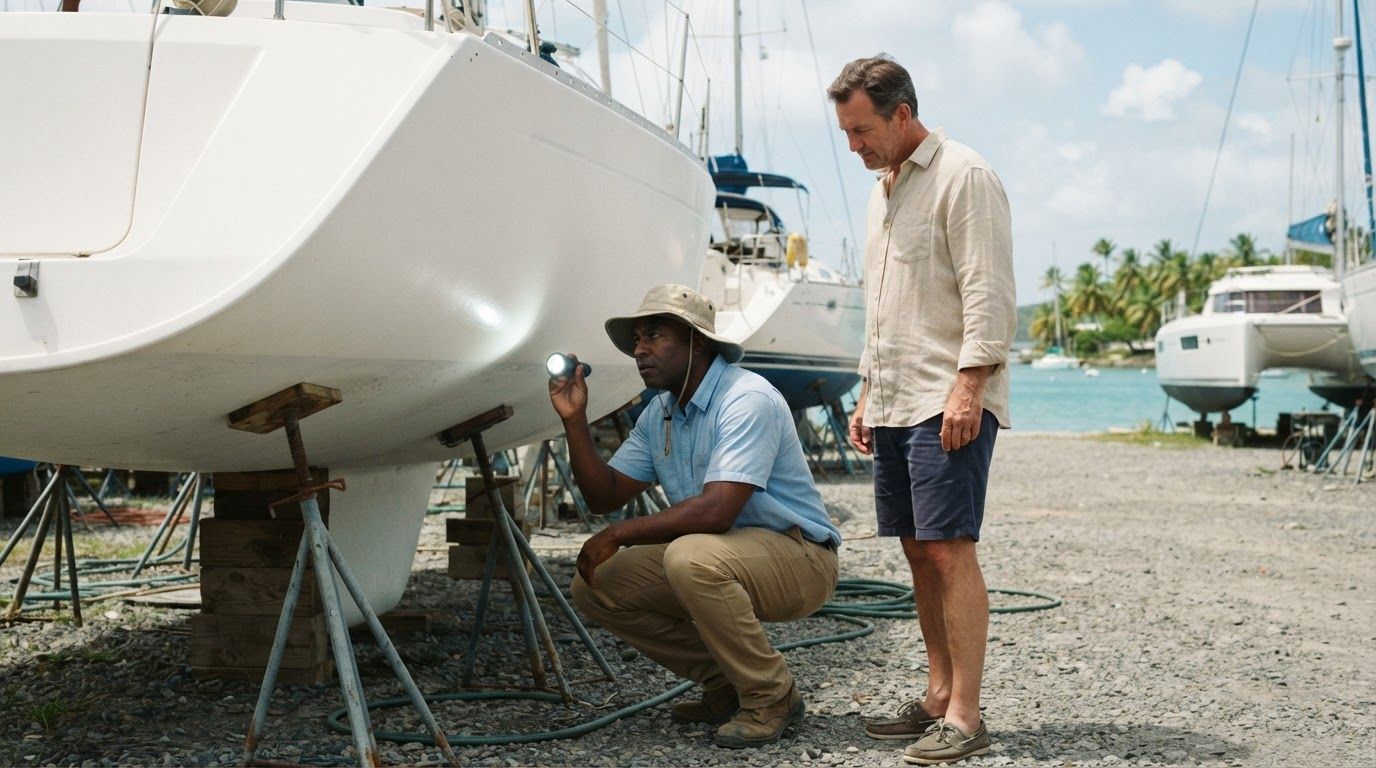
The hull identification number ties the paper to the boat. Recreational boats built for the US market since the early 1970s carry a 12-character hull identification number on the starboard side of the transom, and a second, hidden copy elsewhere on the hull. If the number on the transom does not match the documents, or shows signs of grinding or filling, stop and find out why before going further. Older boats and some foreign builds use different numbering, so a mismatch is a question to answer, not always a fraud, but it must be answered in writing.
The Lien Problem Nobody Mentions
Here is the risk that a clean-looking title does not cover. Under US maritime law, a person who provides necessaries to a vessel on the owner’s order has a maritime lien on the vessel itself and can enforce it by arresting the boat, as set out in 46 U.S.C. § 31342 on establishing maritime liens. Necessaries include repairs, supplies, towage and the use of a dry dock or marine railway.
The important part for a buyer is that a maritime lien attaches to the boat, not to the person who ran up the bill. A yard bill, an unpaid haul-out, unpaid crew wages or a salvage claim can follow the hull to a new owner, and most of these liens are never recorded anywhere you can search. A state title cannot tell you about them and an abstract of title shows only the ones a claimant chose to file. That is why lien protection comes from the contract and the closing process, not from the title alone.
A title is not a lien search
A boat can have a perfect title and still carry an unpaid yard bill that a court will enforce against the hull.
Ask the seller for written confirmation that all yard, storage, mooring and crew bills are paid, check the abstract of title for recorded claims, and make the seller’s warranty of clear title survive the closing.
The Ex-Charter Paperwork Trail
Ex-charter catamarans are a large share of the boats that change hands in the BVI and USVI, and they bring their own paperwork pattern. During its charter life the boat is often owned by a charter company or by an individual owner inside a management program, it may be financed, and it is usually registered where the charter operation is based. When it leaves the fleet, three questions decide whether its papers are clean.
First, who owns it today: the charter company, the program owner, or a lender. Second, has any financing been released and the release recorded where the mortgage was recorded. Third, what is its import and duty status in the territory where it sits now, and what will it be in the territory where you plan to keep it. A boat that was imported temporarily for charter work may not be cleared for private ownership, and that can be a cost the buyer meets at the dock. The tax side of that question is set out in the guide to boat sales tax on offshore purchases.
The hardest version is a boat whose owning company has been dissolved or struck off the register. Nobody may have authority to sign a bill of sale until the company is restored or a court orders the transfer. That can be fixed, but it is the seller’s fix, and the timeline belongs in the contract.
A missing title is a paperwork question. A missing chain of ownership is a legal question, and you should not pay to find out the answer.
When a Missing Title Is a Deal-Breaker
Most missing titles are explainable. These five situations are the ones where walking away is usually cheaper than fixing the problem.
01 · Walk away unless fixed
The hull number does not match the papers
If the number on the transom differs from the documents, or looks altered, there is no paperwork you can trust until a surveyor, the builder and the registry agree on the boat’s identity.
02 · Walk away unless fixed
The owning entity no longer exists
A dissolved company cannot sign a bill of sale. Until it is restored or a court authorizes the sale, nobody can give you good title.
03 · Walk away unless fixed
A mortgage is still recorded
An unreleased preferred ship mortgage or state lien means a lender still has a claim. The release must be recorded, or the payoff must happen through escrow at closing.
04 · Ask hard questions
A storm-total or insurance history
A boat declared a total loss may have been paid out by an insurer that now holds the ownership rights. Get the salvage sale paperwork showing how the seller acquired it.
05 · Walk away
No chain of sale at all
A seller who cannot show how they came to own the boat, and cannot name the person they bought it from, is not offering a bargain.
How a Brokered Sale Closes the Gap
The protection a buyer needs on a boat without a title comes from the process around the sale. A written purchase agreement with a warranty of clear title, a deposit and purchase price held in escrow by a neutral party, a current abstract of title or registry search ordered by the buyer’s side, and a closing where the money moves only when the seller’s documents are in hand: those four things turn a risky private sale into a normal one. The agreement language that does this work is explained in boat purchase agreement clauses that protect the buyer.
The paperwork review should also sit inside your broader buying plan, alongside survey, sea trial and financing, as laid out in how to buy a yacht in the Caribbean. Put ownership questions early: there is no point paying for a haul-out and survey on a boat whose seller cannot sell it.
BVI Yacht Sales offers buyer representation, co-brokerage, and survey and closing guidance from broker offices in Tortola, St. Croix and Annapolis. If a listing you are looking at is missing a title or has a paperwork question you cannot get answered, a buyer’s broker can ask for the records and tell you what is normal for that flag and what is not.
STEP 01Identify the boat's system
Ask whether the boat is state titled, USCG documented or foreign registered, and get a copy of the current certificate.
STEP 02Match the hull to the papers
Check the hull identification number on the transom against the title, documentation or registry certificate and the builder’s records.
STEP 03Search the record
Order a current abstract of title for a documented boat, or ask the flag registry for a transcript of registry showing owners and mortgages.
STEP 04Build the chain of sale
Collect every bill of sale back to the builder’s certificate, or as far as the records allow, and note any gap for the seller to explain.
STEP 05Confirm who can sign
For a company-owned boat, get the company’s good-standing record and a resolution naming the person authorized to sell.
STEP 06Close through escrow
Hold the funds in escrow and release them only against recorded mortgage releases, signed bills of sale and, where needed, a deletion certificate.
Frequently Asked Questions
QCan you legally buy a boat without a title?
Often, yes. Many states do not title small boats, larger US yachts are usually documented with the Coast Guard instead of titled, and foreign-flagged boats carry a registry certificate. The purchase is legal when the seller can prove ownership by other records. It is risky when the boat should have a title and the seller cannot explain why it does not.
QWhat counts as proof of ownership if there is no title?
A consistent set of records: a builder’s certificate, a chain of bills of sale from each owner to the next, a Certificate of Documentation and abstract of title or a foreign registry certificate, and a hull identification number that matches all of them. For a company-owned boat, add the company’s records showing who may sign.
QDo larger yachts even have titles, or are they documented?
Most larger cruising yachts owned by US citizens are documented with the US Coast Guard rather than titled by a state. A vessel must measure at least five net tons to qualify. Documented boats have an abstract of title held by the Coast Guard that lists recorded owners and preferred mortgages.
QHow do you find out whether a boat carries a lien or mortgage?
For a documented boat, order a current abstract of title from the National Vessel Documentation Center. For a foreign-flagged boat, ask the registry for a transcript showing registered mortgages. For a titled boat, the title lists recorded lienholders. None of these show every unpaid yard or crew bill, so also get written confirmation from the seller and a title warranty in the contract.
QWhat paperwork proves ownership of a Caribbean-based or foreign-flagged yacht?
The flag registry’s certificate of registry, a bill of sale from the registered owner, a registry transcript showing any mortgages, and, if the owner is a company, corporate records showing who controls it. If the boat is changing flag, the old registry’s deletion certificate is needed before the new registry will accept it.
QWhat do you do when an ex-charter boat is owned by a company that no longer exists?
Stop until the seller fixes it. A dissolved or struck-off company cannot sign a bill of sale, so the company has to be restored or a court has to authorize the transfer. Make that a condition of the purchase agreement, with a deadline, and keep your deposit in escrow until it is done.
QWhen is a missing title a walk-away?
Walk away when the hull number does not match the papers, when a mortgage is still recorded with no payoff plan at closing, when the owning company no longer exists and the seller will not restore it, or when the seller cannot show how they came to own the boat at all.
Buyer representation
Not sure the paperwork on a boat adds up?
BVI Yacht Sales represents buyers across the BVI, USVI and wider Caribbean, with survey and closing guidance from offices in Tortola, St. Croix and Annapolis. Call 941-900-4510 or send a note with the listing.
Featured Listings
$599,000
$1,300,000
$1,699,000

$299,000

$899,000
$1,795,000

$269,000
$359,000
$499,500
$299,500
$1,290,000
$800,000
$545,000
$564,900
$1,130,000
$159,000
$499,000
$89,000
$89,000
$135,000
$98,250
$149,850
$369,000
$395,000
$349,000
$125,000
$1,724,571
$149,500
$109,900
$395,000

$652,000
$105,000

$115,000
$950,000
$149,000
$135,000
$349,000