
I’ve watched too many yacht deals fall apart over the wrong reasons.
A buyer walks away from a well-maintained vessel because the survey mentions superficial gelcoat blisters. Another buyer proceeds with a purchase despite clear signs of electrical corrosion that will cost six figures to repair.
After decades of Caribbean yacht transactions, I’ve learned this: not all survey findings are created equal. Some are negotiating chips. Others are deal-breakers disguised as minor issues.
The problem is that most buyers don’t know the difference.
The Truth About Survey Reports
Survey reports categorize issues into immediate safety concerns, items requiring attention before use, recommended repairs, and routine maintenance. Understanding these categories helps you prioritize and negotiate effectively.
But here’s what the categories don’t tell you: the Caribbean environment accelerates certain problems while making others less relevant.
A “minor” electrical issue in Maine becomes a catastrophic failure risk in St. Martin. Surface blistering that’s cosmetic in cold water can indicate serious structural problems in tropical heat.
The attempt to find a perfect boat is not the best approach. I’ve seen discriminating buyers take three excellent vessels to survey and find similar issues with all three. The question isn’t whether problems exist. The question is which problems matter.
Osmotic Blistering: When to Worry, When to Walk
Let’s start with the finding that scares buyers most: blisters.
Boats in the Caribbean face a unique challenge. Deck temperatures in tropical climates can exceed 130°F, pushing cabin temperatures toward 100°F. This creates what marine engineers call a “rain-forest environment” that accelerates gelcoat blistering.
The warmer the water, the faster moisture passes through hull laminate. Boats that stay in the water year-round are significantly more susceptible than seasonal vessels.
Here’s what you need to know: osmotic pressure can create fluid pressure in hull voids of up to 700psi. That’s enough to cause serious structural delamination if left unchecked.
But here’s the part most buyers miss.
In 30 years of surveying around 4,000 hulls, veteran marine surveyor David Pascoe found less than 10 cases where blisters resulted in serious structural degradation. That means 99% of blistering involves only the gelcoat and surface mat, not the structural integrity.
The critical distinction: Are the blisters confined to the gelcoat, or has moisture penetrated the structural laminate?
Surface blisters are a negotiating point. Deep laminate moisture is a deal-breaker.
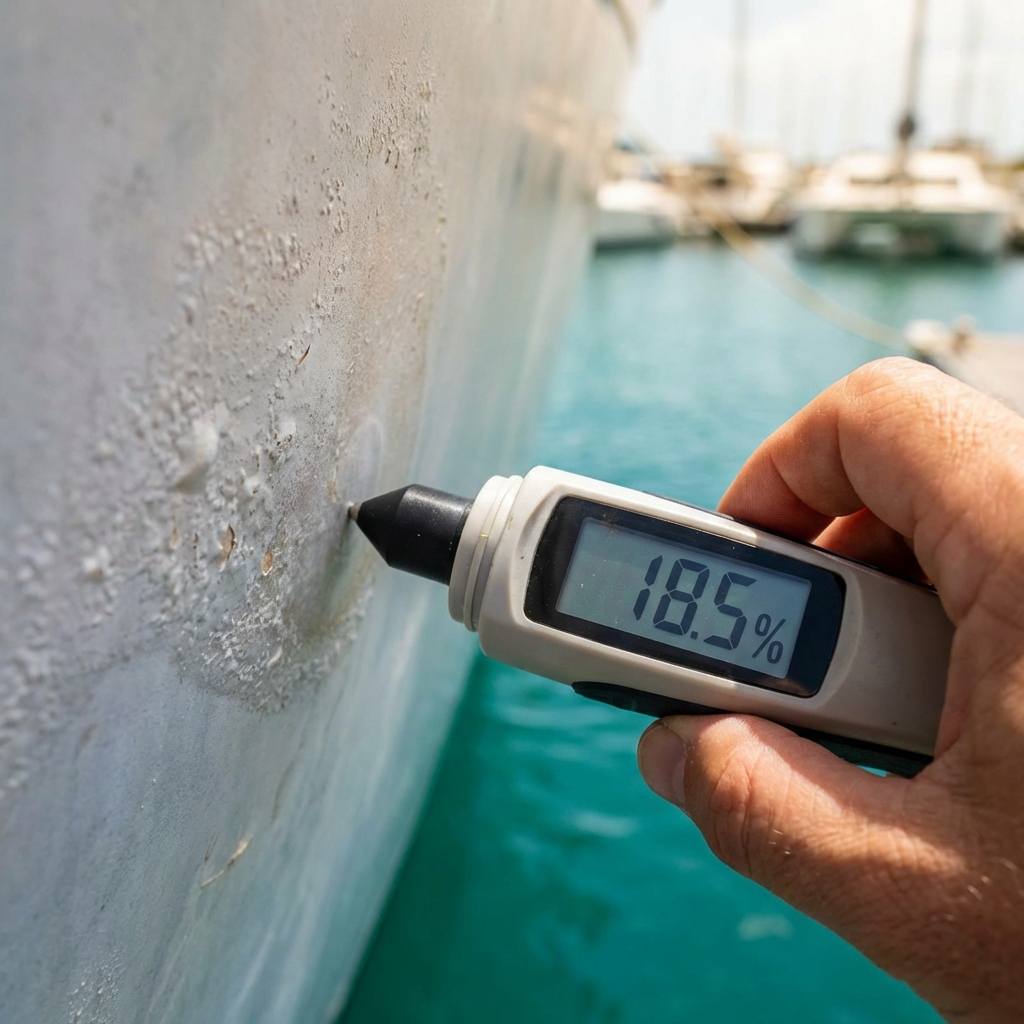
Your surveyor should use a moisture meter at multiple points across the hull. Look for readings above 15% in the laminate itself. Gelcoat moisture is common and manageable. Laminate saturation indicates deferred maintenance or manufacturing defects that will haunt you.
Electrical Systems: The Silent Killer
If I had to choose the single most underestimated risk in Caribbean yacht purchases, it would be electrical systems.
Salt air is relentless. It gets into fittings, wiring, electronics, and moving parts. It corrodes, dries, crusts, reactivates with moisture, and keeps attacking.
After years of additions, removals, and misguided installations, no other system harbors greater potential for starting a fire on a used boat than the electrical system. Both DC and AC systems deserve thorough inspection.
But here’s what makes electrical issues particularly dangerous in the Caribbean: electrolysis is much more destructive than galvanic corrosion, and it’s normally caused by stray electrical current.
I’ve seen beautiful yachts with catastrophic electrical problems hiding behind cosmetic upgrades. The previous owner installed new teak decking and updated the salon. Meanwhile, the main distribution panel is corroded, shore power connections are improvised, and the bonding system is non-existent.
Buyers want to know about existing electrical issues before purchasing because upgrading electrical systems can be extremely expensive and pose serious safety concerns.
What to look for in your survey:
-
Corrosion at connection points and terminals
-
Improvised wiring or bypassed safety systems
-
Missing or inadequate bonding systems
-
Shore power connections that show heat damage
-
Battery compartments with corrosion or inadequate ventilation
A survey that notes “some electrical corrosion” is not describing a minor issue. In the Caribbean environment, electrical corrosion is progressive and accelerating.
💡 Pro tip: Request a dedicated electrical survey if the general survey raises any electrical concerns. The additional cost is minimal compared to the risk.
Deferred Maintenance vs. Normal Wear
Here’s an uncomfortable truth: a very large percentage of used boats for sale have deferred maintenance because owners can no longer afford the boat or maintain it in the condition it should be maintained.
Deferred maintenance is one of the biggest red flags. Signs include corroded hardware, worn running rigging, neglected engine service, and dirty bilges.
But you need to distinguish between deferred maintenance and normal wear.
Normal wear shows up as expected degradation on a vessel that’s been used and enjoyed. The gelcoat has lost some shine. The teak needs refinishing. The canvas shows UV fading.
Deferred maintenance shows up as neglect. The engine service logs are incomplete. The running rigging is overdue for replacement. The through-hulls are original equipment from 20 years ago.
The difference matters because missed survey items don’t stay small in the marine environment. They grow. A small leak becomes rotted bulkheads. A “slightly corroded” fitting becomes a seized or broken part.
I ask myself this question when reviewing surveys: Does this boat show signs of an owner who used it hard and maintained it well, or an owner who stopped caring?
The answer tells you whether the survey findings represent negotiating points or warning signs of deeper problems.
Moisture and Structural Integrity
Excessive moisture readings in cored composite structures indicate water intrusion, which leads to expensive and extensive repairs.
Wet wood coring can rot, allowing the cored deck to separate and drastically reducing its structural integrity. Long-term water exposure causes problems with foam-cored decks as well: core separation, freeze damage, and even disintegration in some cases.
Your surveyor should check moisture levels in the deck, particularly around hardware mounting points, stanchion bases, and anywhere fittings penetrate the deck.
Here’s what most buyers don’t realize: a survey is a snapshot of the boat at that particular moment. There’s no guarantee that an electrical component that powered up during the survey won’t suddenly reach the end of its life the next week.
That’s why moisture readings matter so much. They indicate ongoing problems, not just current failures.
High moisture content in cored structures tells you that water has been entering for some time. The damage is progressive. The repair costs are substantial.
What Surveyors Actually Look For
Marine surveyors look for things that could sink the boat, cause fire, or endanger lives.
Everything else is secondary.
Structural problems involve the integrity of the vessel and its safety. They represent considerable expenditure to fix. If your survey identifies structural concerns, you’re looking at a potential deal-breaker.
If significant issues arise from the survey report, you have three options: walk away, negotiate a lower price, or request that the current owner make repairs before the sale.
I’ve used all three approaches depending on the severity of findings and the overall value of the vessel.
But here’s what I’ve learned: even a “well-maintained” yacht can harbor problems. Hidden rot in the hull, outdated wiring, or engine wear. Without a survey, buyers pay full price for a boat that requires tens of thousands in repairs.
Making the Decision
After you receive the survey, you need to make a decision.
I categorize findings this way:
Walk away immediately:
-
Structural laminate damage or delamination
-
Widespread electrical corrosion or fire hazards
-
Engine problems indicating major mechanical failure
-
Evidence of significant undisclosed damage or repairs
Negotiate price or repairs:
-
Cosmetic gelcoat blistering without laminate moisture
-
Deferred maintenance items with clear scope and cost
-
Systems or equipment approaching end of service life
-
Outdated safety equipment or electronics
Accept as normal wear:
-
Cosmetic gel coat oxidation or minor scratches
-
Canvas or upholstery showing age-appropriate wear
-
Minor hardware corrosion that’s easily addressed
-
Systems functioning properly but not current technology
The discriminating buyer who wants first-class condition often finds that one boat after another has gone to survey and turned out less than anticipated. That’s normal. The key is knowing which findings actually matter.
The Bottom Line
I’ve seen buyers walk away from excellent vessels over superficial issues. I’ve also seen buyers proceed with purchases that turned into financial nightmares.
The difference comes down to understanding which survey findings indicate real problems and which are simply facts about owning a boat in the Caribbean.
Osmotic blistering in the gelcoat? Negotiate the price.
Moisture in the structural laminate? Walk away.
Some electrical corrosion on terminals? Budget for upgrades.
Widespread electrical problems with improvised wiring? Deal-breaker.
Deferred maintenance on a boat that’s otherwise sound? Calculate the cost and adjust your offer.
Deferred maintenance combined with structural concerns? Move on to the next vessel.
The survey isn’t meant to find a perfect boat. It’s meant to tell you what you’re actually buying and whether the price reflects the reality.
Use it that way, and you’ll make better decisions.
Featured Listings
$599,000
$1,300,000
$1,699,000

$299,000

$899,000

$1,795,000

$269,000

$359,000
$499,500
$299,500
$1,290,000
$800,000
$545,000
$564,900
$1,130,000
$159,000
$499,000
$89,000
$89,000
$135,000

$98,250
$149,850
$369,000
$395,000
$349,000
$125,000
$1,724,571
$149,500
$109,900
$395,000

$652,000
$105,000

$115,000
$950,000
$149,000
$135,000
$349,000