
Buying Guide · Engines
Definition
There is no single number. A gas outboard is well used at 1,500 hours; a light-duty marine diesel is barely run-in at the same figure and commonly reaches 5,000 to 8,000 before a major overhaul. What decides the answer is the maintenance record, the duty the engine was worked at, and what an oil sample says today.
“How many hours does it have?” is the first question almost every buyer asks about a used boat, and it is the wrong first question. It feels precise because it produces a number, and buyers trained on cars expect a number to mean something. On a boat, that number is one input among five, and on its own it has misled more buyers in this market than any other single figure on a listing.
Key Takeaways
- 01
Hours are a unit of wear, not of condition — they tell you how much life has been used, not how well it was spent.
- 02
Typical ranges before major work: 1,500–2,500 hours on a four-stroke outboard, 1,000–1,500 on a gas inboard, 5,000–8,000 on a light-duty marine diesel.
- 03
A 2,000-hour engine with a complete service log is a safer buy than a 400-hour engine that has sat unused for six years.
- 04
Ex-charter Caribbean boats carry high hours under professional maintenance — that combination is frequently the best value on the market.
- 05
An oil analysis and a compression or leak-down test cost a fraction of an overhaul and settle the question the hour meter cannot.
How Many Hours Is a Lot? The Short Answer
Split the answer by engine type, because the spread between them is enormous and nothing else in the conversation makes sense until you do.
A four-stroke gasoline outboard is a light, high-revving engine built to a weight target. It is generally considered well used somewhere between 1,500 and 2,500 hours. A gasoline inboard or sterndrive, which spends more of its life at higher load with a heat exchanger and a raw-water circuit working against it, tends to land lower — roughly 1,000 to 1,500 hours before major work is a fair planning assumption.
Marine diesels live in a different world. A light-duty auxiliary of the kind fitted to a cruising sailboat or catamaran — the small Yanmar and Volvo Penta blocks, often on a saildrive — will commonly run 5,000 to 8,000 hours before a serious overhaul, and plenty run past that. A medium-duty diesel in a sportfish or motor yacht, worked harder and rated for intermittent recreational duty, is usually planned around 4,000 to 6,000 hours. A genuinely commercial-rated block is in another category again, with 10,000 to 20,000 hours a normal service life.
Treat all of those as planning ranges, not cliffs. Nothing fails at a round number. What actually happens is that the probability of significant expenditure rises as the hours accumulate, and the maintenance history decides how steeply.
- Four-stroke gas outboard
- 1,500–2,500 hours typical before major work
- Gas inboard / sterndrive
- 1,000–1,500 hours
- Light-duty marine diesel (sailboat auxiliary, saildrive)
- 5,000–8,000 hours
- Medium-duty recreational diesel (sportfish, motor yacht)
- 4,000–6,000 hours
- Commercial-rated diesel
- 10,000–20,000 hours
- Hours per year, typical private owner
- 50–200
- Hours per year, Caribbean charter fleet
- 300–800
Hour Expectancy by Engine Type
The chart below is the same data laid out for comparison, and it makes the single most useful point in this article visible: the same hour reading means completely different things on different transoms. Four hundred hours is trivial on a Yanmar and meaningful on a big gas sterndrive.
The reason is duty rating. Engine manufacturers rate the same block differently depending on how hard and how continuously it is expected to work — a high-output recreational rating assumes short bursts of full power and long periods at part load, while a continuous commercial rating assumes the engine spends its life near its working limit. A recreational engine that has been operated within its rating and serviced on schedule ages predictably. One that has been run at wide-open throttle for hours at a time, or idled for months at a dock, does not.
Typical hours before major overhaul, by engine type
| Gas outboard | 1500 |
| Gas inboard/sterndrive | 1000 |
| Medium-duty diesel | 4000 |
| Light-duty diesel | 5000 |
| Commercial diesel | 10000 |
BVI Yacht Sales, from manufacturer duty ratings and Caribbean market experience
Why Hours Alone Do Not Tell You Much
Here is the part of this that brokers know and listings rarely say: for a marine diesel, low hours are not automatically good news, and are sometimes the opposite.
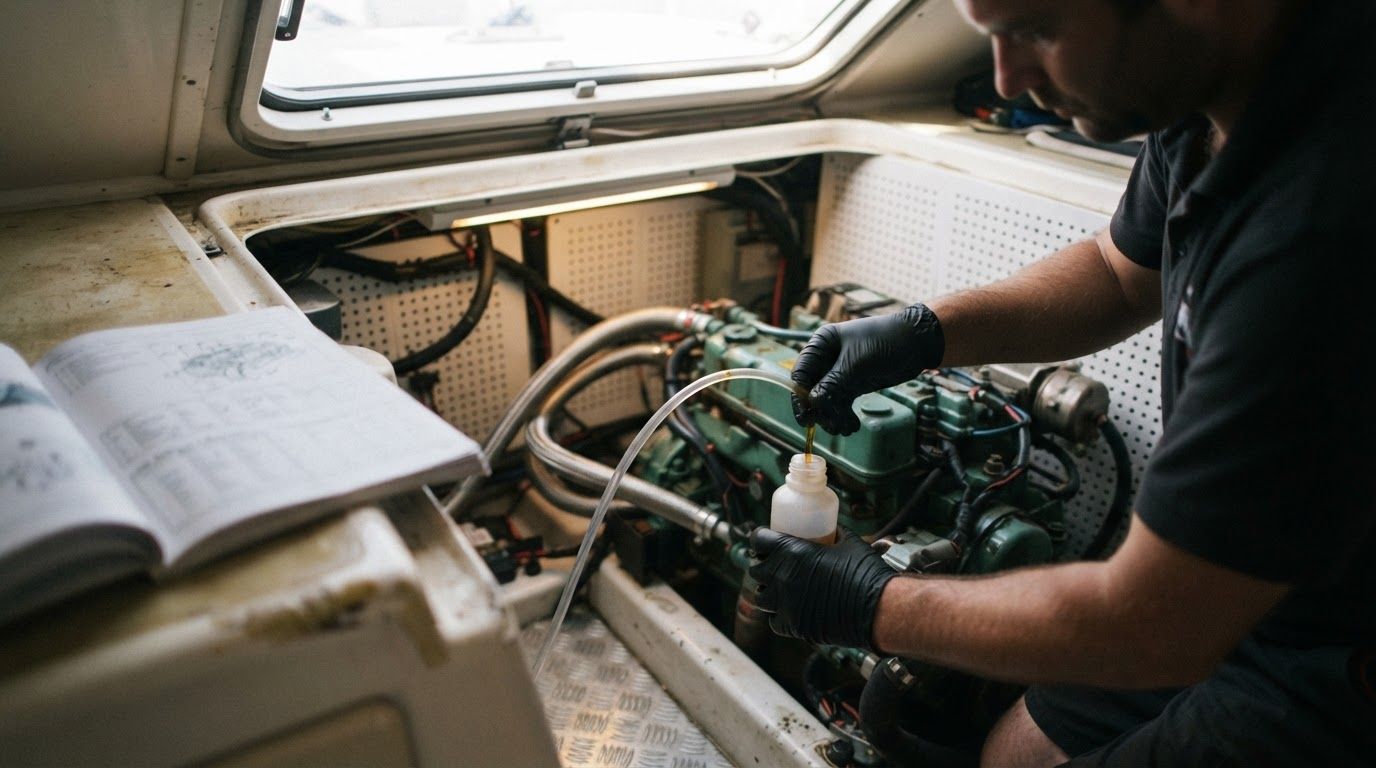
A diesel is happiest working. Run regularly under load, it reaches operating temperature, burns off condensation, keeps the oil circulating over every bearing surface and keeps the injectors clean. Left idle for months at a time, it accumulates water in the crankcase and fuel tank, grows biological contamination in the diesel, corrodes the cylinder walls where oil has drained away, and hardens every rubber component it owns. Raw-water pump impellers take a set. Heat exchangers silt up. Exhaust elbows rot from the inside.
So a 2,000-hour engine with a complete service log — oil and filters at interval, impellers annually, injectors serviced, valve clearances checked, coolant replaced — is a materially safer purchase than a 400-hour engine that has been started twice a year since 2020. We see both every season, and the second one is the one that produces surprise bills in the first twelve months of ownership.
The maintenance record is the document that matters, and it is the one you should ask for before you ask for the hour reading. If there is no log, treat the boat as if the work was not done, because at survey that assumption is usually correct. If the hours give you pause but the boat is otherwise right, the protection belongs in the paperwork, and the buyer clauses in the purchase agreement are what decide who pays for what the survey finds.
Hours measure how much life has been used. The service log tells you how well it was spent — and only one of those two numbers appears on the listing. The hour meter only tells part of the story, and how the engines behave under load shows up in what happens on a sea trial.
The Charter-Fleet Exception
This is the Caribbean market’s particular quirk, and buyers arriving from the US or Europe routinely misread it.
An ex-charter catamaran coming out of a BVI fleet will show hours that look alarming beside a privately owned sister ship — often three to five times as many for the same model year. Charter engines run 300 to 800 hours a year against a private owner’s 50 to 200. On the face of it, that is a boat to avoid.
In practice it is frequently the better engine. Charter fleets service on a fixed schedule because a boat that does not start on a Saturday morning costs them a week of revenue, and the work is done by the same technicians on the same vessels year after year, with records, because the management company’s own money depends on it. Those engines run weekly, under load, at operating temperature, for their whole lives — exactly the regime a diesel wants.
The caution is that everything else on an ex-charter boat has been used by people who did not own it. Sails, canvas, upholstery, winches, ground tackle, heads and electronics all show the miles even when the engines do not. Price that in and the value case frequently still works, which is why a well-documented ex-charter boat or a charter-managed yacht coming off programme is one of the more interesting things on this market at any given moment.
How Hours Are Verified at Survey
Hour meters can be replaced, can fail, and on older installations can simply be wrong. They are also not tamper-proof. Nobody serious relies on the display alone, and neither should you.
Your surveyor and engine surveyor will corroborate the reading against everything else on the boat. Marine surveyors work to the American Boat and Yacht Council standards when writing findings, and a competent one will treat an hour reading as a claim to be tested rather than a fact to be recorded.
STEP 01Cross-check the meter against the paperwork
Service invoices, the engine log and previous survey reports all carry hour readings with dates. Plot them. A consistent line through four or five points is strong evidence; a gap, a reversal or a suspiciously flat period is the thing to ask about.
STEP 02Read the engine's own ECU where one exists
Modern electronically controlled diesels store running hours, fault history and sometimes load profile in the engine control unit, independent of the dash display. A dealer diagnostic session is inexpensive and is the closest thing to an odometer audit that a boat offers.
STEP 03Send an oil sample to a laboratory
Oil analysis reports wear metals, fuel dilution, coolant intrusion and soot loading for well under a hundred dollars per engine. It will not tell you the hours, but it tells you the condition those hours produced, which is the question you actually care about.
Take the sample warm, after running, and take one from each engine.
STEP 04Compression or cylinder leak-down test
The direct measure of the top end. A leak-down test also tells you where the loss is going — rings, valves or head gasket — which converts a vague worry into a priced repair.
STEP 05Sea trial at full operating load
Run the engines to wide-open throttle and hold them there. An engine that cannot reach its rated maximum rpm is overpropped, tired or both. Watch exhaust colour at load, watch temperatures stabilise, and listen at idle afterwards.
STEP 06Physical evidence of age
Paint wear at the service points, the state of the wiring loom, rounded fastener heads, replacement hoses of three different vintages. A hard-worked engine looks it, and the picture either matches the meter or it does not.
All of this belongs in the same inspection as the rest of the vessel rather than as a separate exercise. Our guide to pre-purchase survey cost sets out what a Caribbean survey runs and what the engine survey adds, and the companion piece on the survey findings that actually matter covers how to triage the report you get back so that engine hours are weighted alongside structure, rigging and systems rather than above them.
What High Hours Do to Price
The number that moves
10–20%
typical discount on a diesel at 70–80% of expected life with a complete service record
BVI Yacht Sales brokerage experience, Caribbean market
Hours affect price in a step pattern rather than a smooth curve, because buyers price the next major service event rather than the wear itself.
Through the first half of an engine’s expected life, hours barely move the number. As the engine approaches roughly 70 to 80% of its expected life, the market starts to discount — typically 10 to 20% on the vessel where the record is complete, because a buyer is now pricing an overhaul that is visible on the horizon. Past the nominal expected life, the discount reflects the full cost of a rebuild or repower, less whatever the seller has already spent, and the negotiation becomes a conversation about that one line item rather than about the boat.
The useful consequence for a buyer: a boat just past the discount threshold, with documented maintenance and a clean oil analysis, is often the best value on the market. You are paying for a rebuild that the evidence says is years away. The same logic runs through the broader question of used versus new yachts — depreciation on a hull is gentle and predictable, while depreciation on machinery is lumpy and follows service events, so the buyer who can read machinery gets paid for it.
For a seller, the arithmetic inverts. If your engines are near the threshold and you hold the records, put them in front of the buyer early. A documented service history is worth more at the negotiating table than the same money spent on cosmetics, and it is the single cheapest thing a seller can do to protect the asking price. A boat marketed with the recreational fleet’s usual opacity — and the National Marine Manufacturers Association statistics describe a fleet that is overwhelmingly privately owned and seasonally used, which is to say lightly documented — stands out immediately when the paperwork is complete.
Questions to Ask Before You Make an Offer
01 · Ask the seller
May I see the complete service log?
Not a summary, the documents. Dates, hours, what was done and by whom. If it does not exist, the correct assumption is that the work was not done, and your offer should reflect the cost of finding out.
02 · Ask the seller
How was the boat used, and how often?
Weekly island-hopping under load, or three weeks a year with nine months on a mooring? The pattern of use predicts the failure list more reliably than the total does.
03 · Ask the broker
What has already been replaced, and when?
Impellers, heat exchangers, injectors, exhaust elbows, mounts and raw-water hoses are the consumables that define real condition. An owner who can answer this from memory has been paying attention.
04 · Ask the surveyor
Does the physical evidence match the meter?
Ask directly and get the answer in writing. This is the question an engine surveyor is best placed to answer and the one buyers most often forget to put to him.
05 · Ask yourself
What is the overhaul number, and can I carry it?
Price a full rebuild or repower for these specific engines in this specific market before you offer. If that number would end your ownership, either walk or negotiate it into the price now.
QHow many hours is a lot for a boat engine?
It depends entirely on the engine. A four-stroke gas outboard is well used at 1,500 to 2,500 hours and a gas inboard at 1,000 to 1,500. A light-duty marine diesel is only mid-life at 3,000 and commonly runs to 5,000 to 8,000 hours before a major overhaul. Always ask what kind of engine before you judge the number.
QHow many hours does a marine diesel actually last?
A well-maintained light-duty marine diesel of the kind fitted to cruising sailboats and catamarans typically reaches 5,000 to 8,000 hours before major work, and many exceed that. Medium-duty recreational diesels in sportfish and motor yachts are usually planned around 4,000 to 6,000 hours. Commercial-rated blocks run 10,000 to 20,000. Service discipline moves these figures more than anything else.
QIs a low-hour engine always better than a high-hour one?
No, and on diesels the opposite is common. An engine that sits unused accumulates water in the crankcase and fuel, corrodes internally, and hardens its impellers, hoses and seals. A 2,000-hour engine with a complete service record is usually the safer purchase over a 400-hour engine that has been started twice a year.
QCan boat engine hours be reset or misreported?
Yes. Hour meters fail, get replaced during a refit, and can be tampered with, and older mechanical installations are frequently simply inaccurate. That is why the reading should be corroborated against service invoices, previous survey reports, the engine ECU where one exists, and the physical condition of the engine itself.
QHow do surveyors verify engine hours?
By cross-checking. They plot hour readings from the service log, prior surveys and invoices against dates, pull stored hours and fault history from the engine control unit where the engine is electronically managed, and compare all of it against what the engine physically looks like. Oil analysis and a compression or leak-down test then establish condition independently of the claimed hours.
QHow much do engine hours move a boat's asking price?
Very little through the first half of expected life. As the engine passes roughly 70 to 80% of it, expect the market to discount the vessel by 10 to 20% where the service record is complete. Beyond nominal expected life, the discount converges on the cost of a rebuild or repower less whatever the seller has already invested.
QShould I avoid an ex-charter boat because of its engine hours?
No — judge it on the whole package. Charter engines run 300 to 800 hours a year but are serviced on a fixed schedule by the same technicians with records kept, which is close to ideal for a diesel. The wear on an ex-charter boat shows up in sails, canvas, upholstery, winches and interior fittings rather than in the machinery, so price those and treat the engines on their documented merits.
The Informative Brokers · Tortola · St. Croix · Annapolis
Have the engines read before you make the offer
Send us the listing you are considering and we will tell you what those hours mean on that specific engine in this market, and what to have the surveyor check. Buyer representation costs you nothing on a co-brokered sale.
Featured Listings
$599,000
$1,300,000
$1,699,000

$299,000

$899,000
$1,795,000

$269,000
$359,000
$499,500
$299,500
$1,290,000
$800,000
$545,000
$564,900
$1,130,000
$159,000
$499,000
$89,000
$89,000
$135,000
$98,250
$149,850
$369,000
$395,000
$349,000
$125,000
$1,724,571
$149,500
$109,900
$395,000

$652,000
$105,000

$115,000
$950,000
$149,000
$135,000
$349,000