
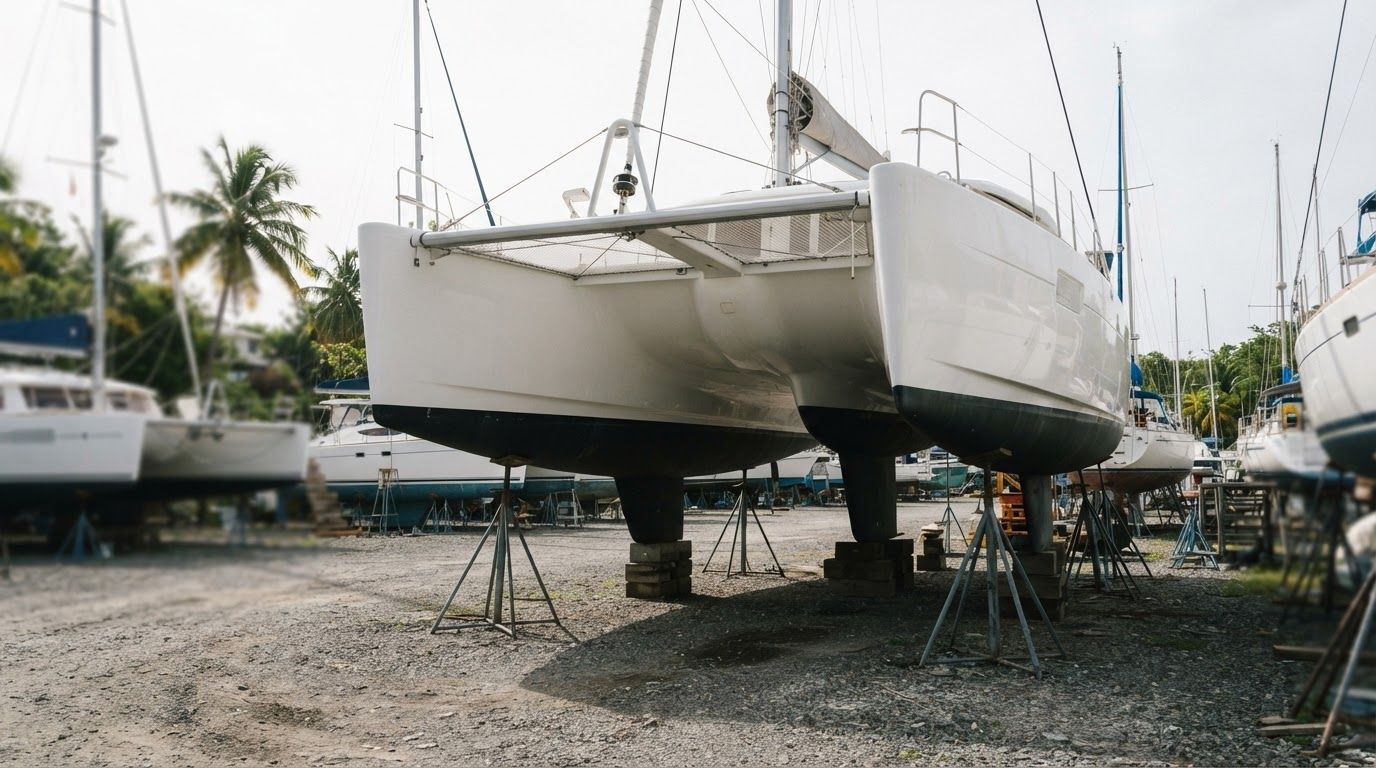
Two slender hulls do all the work on a catamaran. The numbers that describe them — clearance, beam ratio, payload, appendages — tell you more about how a boat will ride than any brochure photograph.
What matters most
- 01
Clearance is the comfort number — Bridgedeck height above the water is the single design figure most closely tied to how much a catamaran slams in a seaway. Roughly 4% of overall length is low, 5% acceptable, 6% good.
- 02
Daggerboards buy angle, keels buy tolerance — Boards point higher and slip sideways less; mini-keels let you touch bottom, dry out and forget about a trunk that can leak.
- 03
Payload eats clearance — Slender hulls sink fast when loaded. Fuel, water, tender, ground tackle and a season of belongings can cost several inches of the clearance you paid for.
- 04
Inspect the hulls, not the cushions — Keel stub joints, daggerboard trunks, fairing thickness and blistering below the waterline are where the real money hides on a used multihull.
What Defines a Catamaran Hull
A catamaran hull is one of two slender, widely spaced hulls joined by a bridgedeck. Each hull carries roughly half the boat’s displacement, so it can be much narrower than a monohull of the same weight. Hull slenderness, bridgedeck clearance and the choice between daggerboards and mini-keels decide how a catamaran sails and how it rides.
That is the whole design in one paragraph, and it explains why catamarans behave the way they do. A monohull carries its weight in one fat hull and stands up to its sails with ballast. A catamaran carries the same weight in two thin hulls and stands up to its sails with width. Every consequence follows from that: shallow draft, no ballast to drag around, level sailing, a lot of interior volume for the length — and a structure that has to bridge the gap between the hulls without being pounded apart.
The characteristic feature of a catamaran hull, then, is its length-to-beam ratio. A cruising catamaran hull typically runs somewhere between 8:1 and 12:1 — long and narrow. A performance multihull pushes higher. The narrower the hull, the less wave-making drag it creates for a given speed, which is why two slim hulls can be faster than one wide one despite having more wetted surface between them. It is also why load matters so much, a point we come back to below.
Two hulls is the definition, not a variable: a catamaran has exactly two. Three is a trimaran, and the practical differences between them are worth a separate read if you are still choosing a platform. What varies between catamarans is everything above and below those two hulls.
Definition
Bridgedeck — The structure spanning the two hulls, carrying the saloon, cockpit and often the galley. Its underside is the surface that waves strike, so the gap between it and the water — bridgedeck clearance — is a comfort-critical dimension. Some designs add a nacelle, a shallow central pod below the bridgedeck, which lowers effective clearance in exchange for interior headroom.
Bridgedeck Clearance and Slamming
Sail a catamaran upwind into a short chop and you will hear it: a hollow bang under the saloon floor as a wave crest meets the bridgedeck. That is slamming, and it is the most common complaint owners make about boats that looked perfect at the dock. It is loud, it is tiring on a night passage, and over years it is a structural fatigue load. It is also largely predictable from the drawings.
The working rules among multihull designers are expressed as a fraction of overall length. Around 4% of LOA is low and will slam readily. 5% is acceptable for coastal work. 6% or better is what you want for ocean passages. A 45-foot catamaran at 6% has about 32 inches of clearance; the same boat at 4% has about 21 inches, and those eleven inches are the difference between a quiet night and no sleep. Richard Woods on bridgedeck slamming makes the point that clearance is a primary predictor of slamming behaviour and that more of it simply produces less of it.
There is a second rule for unusually wide boats. Where beam exceeds half the overall length, designers also check clearance against the span between the hulls, looking for a minimum of about 20% of that span. The older workshop version of the same idea — one inch of clearance per foot of beam, rising to 1.3 inches on wider boats and 1.8 on very square ones — gets you to a similar place with no calculator.
Bridgedeck clearance benchmarks
| Clearance as % of LOA | Verdict | What it feels like | Worked example on a 45-footer |
|---|---|---|---|
| Below 4% | Marginal | Slams in a moderate chop, even off the wind | Under 21 in |
| 4% | Low | Noticeable pounding upwind; fine in flat water | About 21 in |
| 5% | Acceptable | Comfortable coastal cruising, occasional bangs | About 27 in |
| 6% | Good | Quiet on passage in most sea states | About 32 in |
| Above 6% | Generous | Typical of ocean-oriented and performance designs | Over 32 in |
Two cautions when you use this table. First, measure the boat you are actually buying, loaded the way you will actually cruise it — not the specification sheet. Second, clearance is not free: raising the bridgedeck raises the centre of gravity and the windage, and it puts the saloon floor further from the water. Designers trade it against other things deliberately, which is why a lower-clearance boat is not automatically a bad boat. It is a boat with a different intended use.
Daggerboards vs Mini-Keels
Below the waterline, a cruising catamaran does one of two things for lateral resistance. It either has fixed, shallow mini-keels moulded to each hull, or it has daggerboards that drop through trunks in the hulls. This is the most consequential specification difference between two otherwise similar boats, and it divides the market cleanly.
Daggerboards
- Upwind angle Points several degrees higher, with markedly less leeway
- Light-air performance Clear advantage — less wetted area, more lift when needed
- Above about 10 knots Advantage narrows considerably
- Grounding Board must be raised; the trunk and hull take the risk
- Draft Very shallow with boards up
- Drying out / careening Awkward
- Maintenance Trunks, seals, board bearings, potential leaks
- Crew workload Boards up and down with every change of course and depth
Mini-keels
- Upwind angle Gives up angle, especially in light air
- Light-air performance Wetted area is always there
- Above about 10 knots Works efficiently; the practical gap gets small
- Grounding Designed to take the hit; many are sacrificial
- Draft Fixed, shallow, predictable
- Drying out / careening Straightforward — the boat stands on its keels
- Maintenance Almost none beyond antifouling and impact repair
- Crew workload Nothing to do
For Caribbean cruising the calculus usually favours keels, and it is worth being blunt about why. The trade winds blow, the reefs are shallow and hard, and much of the sailing is a reach rather than a beat. A boat that gives up two degrees of pointing and never asks you to think about a daggerboard trunk is the easier boat to own here. The best catamarans for liveaboard cruising in this region are, more often than not, keeled boats for exactly that reason, and the picture changes again if you are weighing power versus sailing catamarans, where lateral resistance stops being the question at all.
That is a preference, not a rule. If you sail somewhere with light air and deep water, and you care about windward performance, boards earn their keep. Charter fleets specify keels almost universally because they are forgiving of guests and of coral, which has a downstream effect on what appears on the used market — the ex-charter catamaran prices that dominate Caribbean listings are overwhelmingly keeled boats, so a boarded cruiser here is a deliberate hunt rather than a shelf item. It is also one of the sharper contrasts in any honest comparison of a catamaran versus monohull, where a fin-keeled monohull simply does not have the option. Hull form drives price as much as length does, and Caribbean catamaran prices show how much a bridgedeck and daggerboard specification adds over a simpler production layout.
Load Carrying and Why Overloading Ruins Performance
Slender hulls are efficient and unforgiving in the same breath. Because each hull is narrow, it has relatively little waterplane area — the horizontal slice of hull at the waterline that resists sinking. Add weight and a catamaran settles noticeably further down than a beamy monohull would for the same load. Designers quote this as pounds per inch of immersion, and on a mid-size cruising cat it is a smaller number than owners expect.
The consequences compound. Sinking the hulls increases wetted surface and displacement, which costs speed. It also reduces the bridgedeck clearance you carefully checked at the dock — a boat with an honest 5% of LOA empty can be down to 4% once it is provisioned, tankage full, with a tender on davits, a generator, a watermaker, ground tackle, tools, spares, dive gear and two people’s belongings aboard. The boat you sail is not the boat you surveyed unless you account for that.
So treat the payload figure as a real specification, not a footnote. Ask what the quoted displacement includes. Weigh the big items honestly: full fuel and water, the tender and outboard, chain and anchors. Then look at where the weight sits — heavy items in the ends of slender hulls make a catamaran hobbyhorse, and weight high up in the bridgedeck raises the centre of gravity. Owners who load thoughtfully keep most of the performance they paid for; owners who treat a catamaran like a warehouse do not.
Hull constraints
Design limits worth respecting
- hard
Payload is finite and the penalty is immediate. Exceeding designed displacement costs speed, clearance and motion comfort all at once.
Get the real light-ship weight, then budget your own load against the designer’s figure before you commit.
- hard
A daggerboard trunk is a hole through the hull. Seals, bearings and the trunk laminate are all maintenance items and all potential leak paths.
On a used boarded boat, have the trunks inspected specifically and budget for the seals.
- soft
A nacelle or low central pod trades bridgedeck clearance for headroom and volume.
Measure clearance at the lowest point of the structure, not at the hull sides.
- soft
Bridgedeck clearance cannot be added later. It is fixed at the moulding stage.
Treat it as a selection criterion rather than something to fix; it is one of the few figures you cannot refit.
- info
Wide beam limits where you can berth and haul. Many yards and marinas price multihulls at a premium or cannot take them at all.
Confirm haul-out capability and slip availability in your intended cruising area before purchase.
What a Buyer Should Inspect on the Hulls
A catamaran gives a surveyor twice the hull to look at and several structures a monohull does not have. Interiors sell boats and hulls cost money, so spend your attention below the waterline and at the joints.
1
Keel-to-hull joints
Mini-keels are bonded or moulded to the hull and they are the first thing to take a grounding. Look for stress cracking around the joint, evidence of past repair, and moisture in the laminate above it. A sacrificial keel that has done its job is good news; a keel joint that has been repaired badly is not.
2
Daggerboard trunks and boards
Check the trunk laminate for delamination and the board itself for impact damage and core saturation. Ask whether the boat has a crash box or similar arrangement designed so a board shears away rather than loading the hull structure on hard impact.
3
Osmotic blistering and fairing
Two hulls means twice the below-waterline area. Blistering on an older polyester hull is common and usually manageable, but the cost scales with area. Heavy fairing compound — sometimes used to smooth a rough moulding — adds weight and can crack and hold water.
4
Bridgedeck underside and forebeam
Look for repeated slamming damage: crazing, print-through, or repairs under the saloon floor. The forebeam and its connection to the hulls carry rig loads and take the worst of head-sea impacts.
5
Saildrives, rudders and bearings
Two of everything, and on a keeled boat these are often the deepest points. Check rudder bearings for play and saildrive diaphragms for age — the replacement interval is time-based, not hours-based.
None of this is a reason to hesitate about a multihull; it is a reason to survey one properly. A competent pre-purchase survey on a catamaran takes longer and costs more than the same job on a monohull of similar value, precisely because there is more to examine. Understanding what drives pre-purchase survey costs in the Caribbean before you make an offer keeps that expense from arriving as a surprise mid-deal, and a haul-out survey is the only place several of the items above can be assessed at all.
Our brokers walk these hulls for a living, in a market where most of the inventory has spent its life in salt water and sunshine. If you want a candid read on a specific boat’s clearance, appendages or laminate history before you spend money on a survey, ask.
Frequently Asked Questions
QWhat is bridgedeck clearance and why does it matter?
It is the vertical gap between the water and the underside of the structure joining the two hulls. It matters because that underside is what waves hit. Designers aim for roughly 5 to 6% of overall length; below about 4% a boat will slam readily in a chop, which is uncomfortable, noisy and a long-term fatigue load on the structure.
QDo daggerboards make a catamaran sail better?
Upwind, measurably yes. Comparative testing on identical hulls showed a boarded boat pointing up to 5 degrees higher with 2 to 5 degrees less leeway, and a board generates about twice the lift of a shallow mini-keel with roughly 20% less drag when fully down. The advantage is largest in light air and narrows considerably above about 10 knots of breeze.
QAre mini-keels or daggerboards better for cruising?
For most cruising — and for the Caribbean in particular — mini-keels are the easier choice. They tolerate grounding, allow the boat to dry out, add nothing to the crew’s workload and have no trunk to leak. Daggerboards are the better answer if windward performance is a priority and you sail in deep water with lighter air. Neither is safer in the abstract; they fail differently.
QWhy do some catamarans slam in a seaway?
Almost always because there is not enough clear air under the bridgedeck for the sea state — either the design is low to begin with, or the boat has been loaded until it sits deeper than intended. Hull shape and the presence of a nacelle contribute, but clearance and trim dominate. Slowing down, changing course relative to the waves, and moving weight out of the bows all help.
QHow does hull shape affect load carrying?
Slender hulls have little waterplane area, so they sink more per pound added than a wide monohull would. That costs speed, increases wetted surface and quietly reduces bridgedeck clearance. Ask for the designed payload and light-ship displacement, then budget your own gear, tankage and tender against it rather than assuming there is slack.
QWhat hull features should a buyer inspect?
Keel-to-hull joints for grounding damage and past repairs, daggerboard trunks and boards where fitted, the below-waterline laminate for osmotic blistering and excessive fairing, the bridgedeck underside and forebeam for slamming damage, and rudder bearings and saildrive diaphragms. On a catamaran there are two of most things, so budget survey time accordingly.
Talk to a broker who has sailed these boats
Our brokers work the Caribbean multihull market from offices in Tortola, St. Croix and Annapolis. If you are weighing two catamarans and want a straight answer on clearance, appendages or what a survey is likely to find, get in touch.
Reviewed
Featured Listings
$599,000
$1,300,000
$1,699,000

$299,000

$899,000

$1,795,000

$269,000
$359,000
$499,500
$299,500
$1,290,000
$800,000
$545,000
$564,900
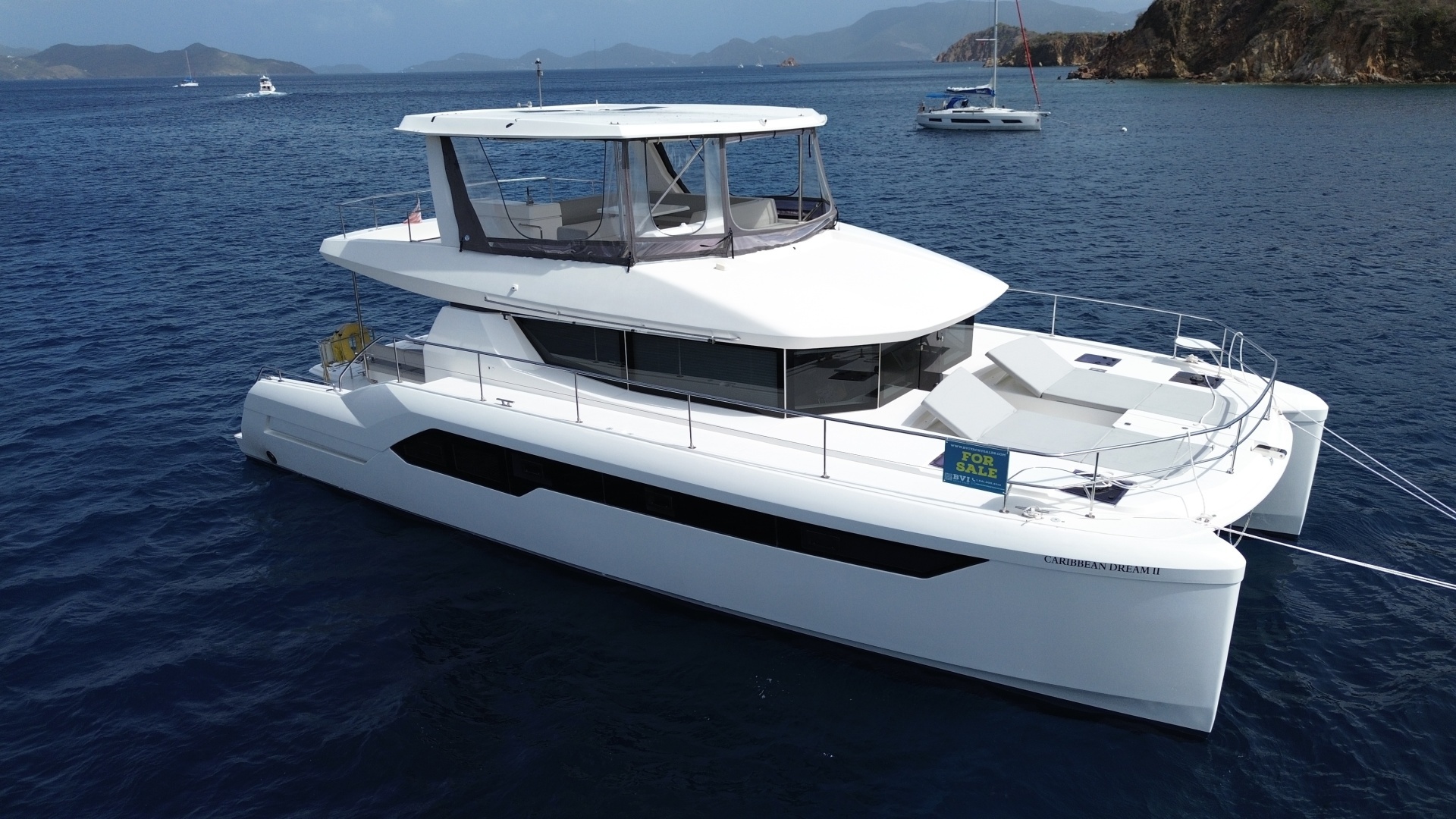
$1,130,000
$159,000
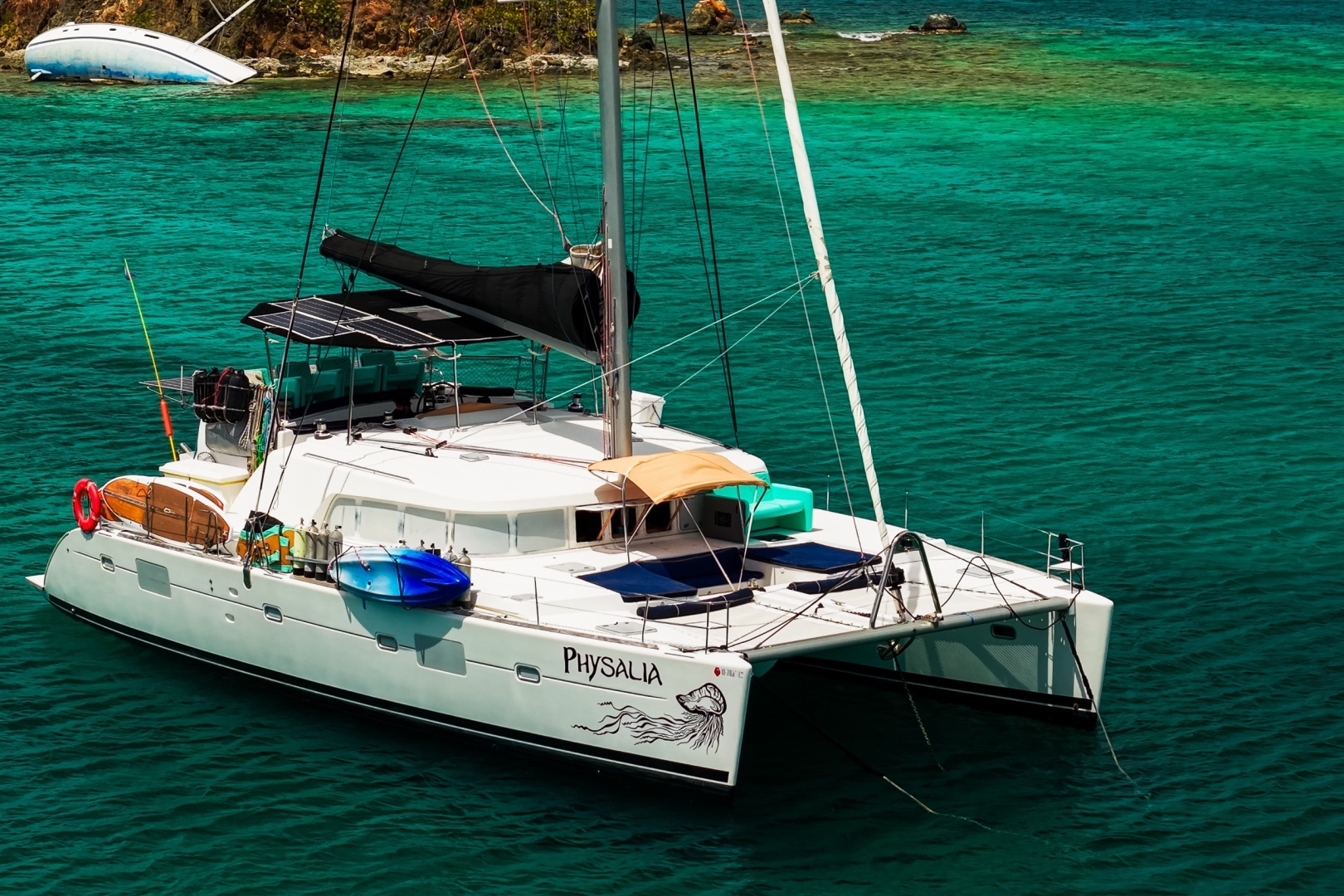
$499,000
$89,000
$89,000
$135,000
$98,250
$149,850
$369,000
$395,000
$349,000
$125,000
$1,724,571
$149,500
$109,900
$395,000

$652,000
$105,000

$115,000
$950,000
$149,000
$135,000
$349,000