
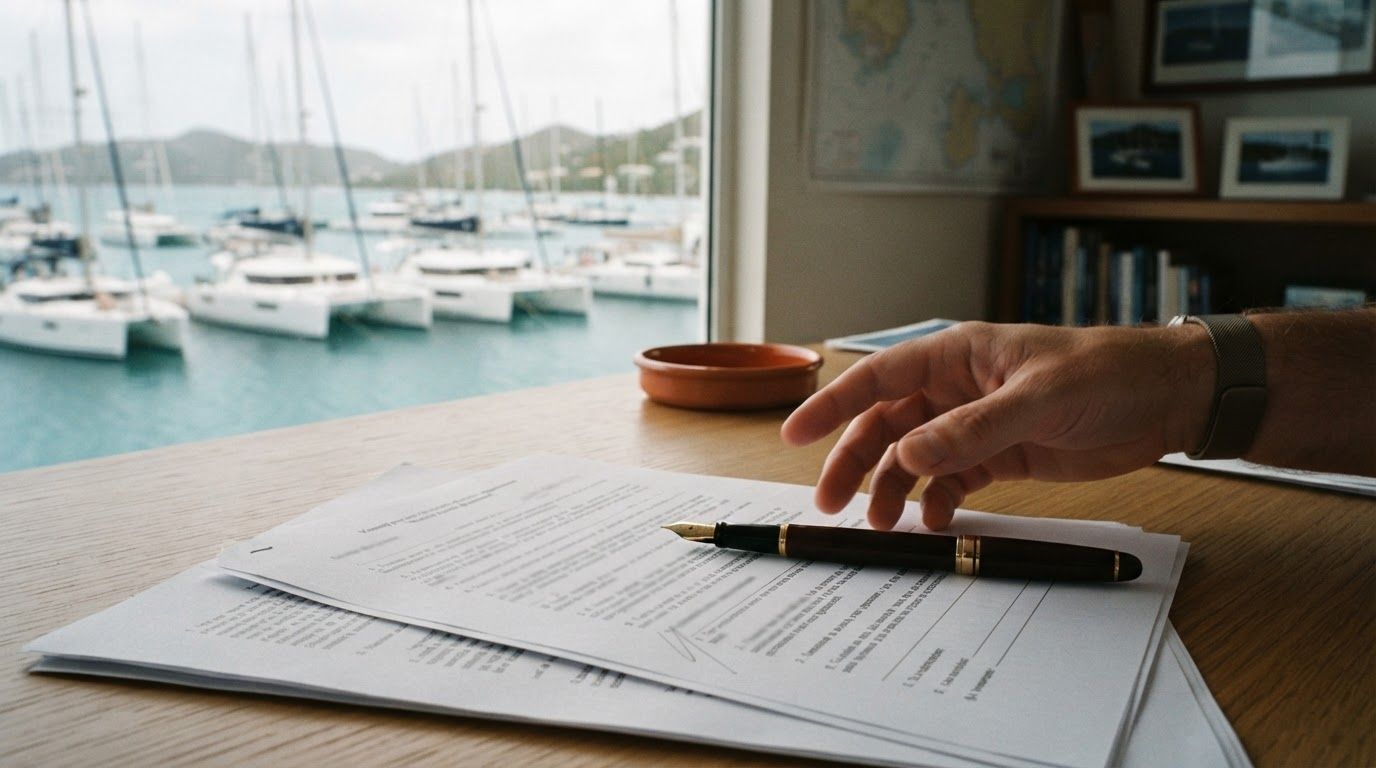
Buying Guide · Caribbean
A boat purchase agreement is a binding offer with conditions attached. It fixes the price, sets what the deposit does, defines the survey and sea trial you may reject on, and names the moment risk in the vessel passes from the seller to you. Every clause moves risk across the table in one direction or the other.
Before you sign
- 01
The agreement binds you when signed and the deposit is paid — the conditions are what make it escapable.
- 02
The acceptance of vessel date is the clause buyers miss most: silence past it is usually acceptance.
- 03
Deposits are customarily 10% and should sit in the broker’s escrow account, not the seller’s.
- 04
“As-is where-is” does not cancel the seller’s warranty of title — those are separate promises.
- 05
A vessel lying in the BVI or USVI adds flag, import and offshore-closing questions the standard form does not address.
What a Boat Purchase Agreement Actually Does
Most explanations of a boat purchase agreement list the fields you have to fill in. That is not the useful part. The useful part is that every clause answers one question — who carries the risk, and from when — and that the answers change depending on what the document says.
Four things the agreement establishes are worth understanding before you look at any specific wording. It converts a negotiation into a binding offer once both parties sign and the deposit is paid. It sets out the conditions under which that binding offer can be escaped without penalty. It names the deadlines by which each condition must be exercised. And it fixes the point at which risk of loss in the vessel — fire, sinking, hurricane — moves from the seller to the buyer.
Everything else in the document is detail arranged around those four things.
Read this before the clause list
The agreement binds you; the contingencies release you
Buyers often assume the deposit is what commits them and the contract is a formality. It is the other way round. Signature and deposit create the obligation; the survey, sea trial and acceptance clauses are the specific, dated exits from it. Miss a date and the exit closes.
The Clauses That Decide Who Carries the Risk
Deposit and Escrow: How Much, Who Holds It
Ten percent of the purchase price is the customary deposit in brokerage transactions, and it is paid on signature rather than at closing. The figure is negotiable, particularly on higher-value vessels, but a seller who wants materially more than ten percent is asking you to fund a larger part of their risk than the market convention.
Where the money sits matters more than how much it is. It should be held in the listing broker’s escrow or client account, not paid to the seller. An escrow account is subject to professional obligations about release; money in a seller’s account is subject only to the seller. If you are asked to wire a deposit directly to an individual, that alone is reason to pause. The mechanics of how brokerage commission works out of the same closing statement are worth understanding at the same time, because they explain who is holding what and why.
Release conditions belong in writing. The deposit should be released to the seller on closing, returned to the buyer on a valid rejection within the contingency period, and — crucially — held pending resolution rather than released unilaterally if there is a dispute.
Subject to Survey and Sea Trial
This is the clause that makes the whole structure work, and it needs three things to be effective. It must give you the right to a survey at your expense and at a time you can arrange. It must give you the right to a sea trial, in sea conditions adequate to test the vessel. And it must let you reject on the results, in your own judgement, rather than only where a surveyor certifies a defect above a monetary threshold.
That last distinction is where buyers get caught. A clause permitting rejection only for “material defects” invites a dispute about materiality. A clause permitting rejection at the buyer’s sole discretion within the period does not. Push for the second.
Give yourself a realistic window. Between arranging a surveyor, hauling the vessel and receiving a written report, ten to fourteen days is tight in the Caribbean and fifteen is more comfortable in season. Budget for it too — our breakdown of pre-purchase survey cost sets out what a survey and short haul run in this region.
Acceptance of Vessel — the Date Most Buyers Miss
Hidden inside almost every standard form is a date by which the buyer must either accept the vessel, reject it, or propose an amended offer following the survey. Past that date, in most standard forms, silence counts as acceptance. The contingencies close, the deposit becomes non-refundable, and the buyer who was still waiting for a second quote on the rigging discovers they now own a boat.
Diarise the acceptance date the day you sign. Not the survey date — the acceptance date, which sits some days after it. If the surveyor’s written report will not arrive in time, ask for an extension in writing before the deadline rather than after. Sellers grant reasonable extensions routinely; what they will not do is reopen a deadline that has already passed.
Warranty of Title, Liens and Encumbrances
The seller warrants that they own the vessel and that they will deliver it free of liens, mortgages and other encumbrances. This warranty is separate from the condition of the boat, and it survives an “as-is” sale — the two clauses do different work and one does not cancel the other.
Verification is a real step, not a formality. For a US-documented vessel, an abstract of title from the Coast Guard’s documentation office lists recorded instruments against the hull, including preferred ship mortgages; the federal vessel documentation rules set out how that record is maintained. A lien search covers the instruments that do not appear there — unpaid yard bills and crew wages chief among them, both of which can attach to the vessel rather than to the seller.
Ex-charter boats deserve extra attention. A vessel that has been in a charter management programme may have obligations to the charter company, outstanding maintenance reserves or a management agreement that does not simply evaporate on sale. Ask for the programme paperwork before the acceptance date, not after. Our guide to yacht title transfer and documentation covers the sell-side of the same process in detail.
As-Is Where-Is and What It Does Not Cover
“As-is, where-is, with all faults” means the seller makes no promise about condition. It is the normal basis for a brokerage sale and it is not, by itself, a warning sign. What it means in practice is that your survey is the only protection you have on condition, which is precisely why the survey contingency has to be drafted properly.
What it does not do: it does not release the seller from the warranty of title, it does not override any express representation they made in writing, and it does not excuse active concealment. If the seller states in the listing that the engines were rebuilt last season, that statement does not vanish because the sale is as-is. Keep the listing particulars and any written exchanges — they can matter later.
Closing Date, Place of Delivery and Risk of Loss
Three linked questions: when does the sale complete, where is the vessel handed over, and at what moment does risk pass. Standard forms pass risk on delivery, which is usually simultaneous with closing, but variants exist and it is worth reading which one you have.
The practical consequence is insurance. Your cover needs to begin at the moment risk passes and not a day later. In the Caribbean, where the closing may happen with the boat on the hard in one territory and the buyer in another, that moment deserves to be spelled out in the agreement rather than assumed.
Place of delivery carries its own weight. A boat delivered in the BVI is a different transaction, for tax and import purposes, from the same boat delivered in Florida.
Deposit, Survey and Closing: The Money Timeline
Day 0
Offer signed, deposit paid
Both parties sign. Ten percent goes to the broker’s escrow account. The agreement is now binding, subject to the contingencies.
Days 1–10
Survey and sea trial
Surveyor appointed, vessel hauled, sea trial run. Engine survey often separate and separately booked. Costs are the buyer’s.
Days 10–15
Acceptance, rejection or amended offer
The written report arrives and the decision must be made by the stated date. Accept, reject and recover the deposit, or come back with an amended figure. Silence is acceptance.
Days 15–30
Title search, funds and documentation
Abstract of title and lien search completed. Financing finalised. Closing statement drafted. Registration and flag paperwork prepared.
Closing day
Funds exchanged, bill of sale delivered
Balance wired, bill of sale executed, deposit released to the seller, risk and ownership pass to the buyer. Insurance must already be live.
Buying a Yacht Lying in the BVI or USVI
This is the part no standard form addresses and the part we handle every week. A vessel lying offshore raises four questions that a domestic purchase never poses.
Where does the closing happen? Offshore closings — completing with the vessel outside US waters — are common in this market and have consequences for tax and for import that are worth planning rather than discovering. Our explanation of boat sales tax on offshore purchases sets out where the liabilities fall.
Under what flag will the boat be registered? Changing flag is not instantaneous, and the timing has to be coordinated with the closing so that the vessel is never left without valid registration. Where will she be after closing, and does she need a cruising permit or a temporary import entry in that territory? And finally, who will move her — the delivery crew, the insurance for the passage, and whose risk applies during it.
None of these are obstacles. They are simply items that need to be on the timeline from day one rather than raised in the final week. That sequencing is most of what a buyer’s broker does here, and it is the background to everything in our wider guide to buying a yacht in the Caribbean.
Standard Brokerage Form vs a Downloaded Template
Search for a boat purchase agreement and you will find free template PDFs, some of them written for a different country and most of them written for a $15,000 runabout. They are not the same instrument as the industry forms, and the difference is not sophistication for its own sake.
Industry brokerage form
- ✓Contingencies, deadlines and escrow terms already drafted and tested
- ✓Acceptance-of-vessel mechanism defined with a clear date
- ✓Title warranty and lien provisions written to survive an as-is sale
- ◦Assumes a brokered transaction with an escrow agent
Downloaded template PDF
- ✓Free and immediately available
- ✗Frequently drafted for another jurisdiction
- ✗Survey contingency often vague or absent
- ✗No escrow structure and no acceptance deadline
- ✗Silent on offshore delivery, flag and import
The International Yacht Brokers Association publishes the purchase and sale forms most widely used across US and Caribbean brokerage transactions. They are drafted to allocate risk between the parties rather than to favour either, which is exactly what you want in a starting document — amendments then become a visible negotiation rather than a hidden advantage.
Five Amendments Worth Asking For
01 · Contingency
Rejection at the buyer's sole discretion
Replace any wording that limits rejection to defects above a threshold or certified as material. Sole discretion within the contingency period removes an entire category of dispute.
02 · Timing
A survey window that reflects Caribbean logistics
Fifteen days rather than ten, and an explicit right to extend once in writing if the haul-out or the surveyor’s availability slips. Yards here run full in season.
03 · Escrow
Disputed deposits held, not released
Language requiring the escrow agent to hold funds pending written agreement or determination, rather than releasing on one party’s demand.
04 · Title
Delivery conditional on a clean lien search
Make the seller’s obligation to deliver free of encumbrances a condition of closing, with the search completed and reviewed before funds move.
05 · Offshore
Place of closing and flag timing named in the contract
Where the sale completes, under what flag she will be registered afterwards, and who carries risk during any delivery passage. Assumption is the expensive option.
The clause buyers regret is almost never the one they argued about. It is the acceptance date they never diarised.
BVI Yacht SalesDo You Need a Lawyer?
For a straightforward brokered purchase on a standard form, with a competent broker on each side and an escrow account holding the deposit, many buyers complete without separate legal representation. The form does most of the protective work and the brokers administer the deadlines.
A maritime lawyer earns their fee in four situations: where the vessel carries a recorded mortgage or a disputed lien, where the transaction is structured through a corporate owner, where an ex-charter programme has obligations attached, or where the amounts involved make the cost immaterial relative to the risk. If you are unsure which category you are in, that uncertainty is itself a reason to ask. We will tell you when we think a transaction needs counsel, and buyer representation in the BVI includes flagging exactly that.
Buy-side support
Have a broker on your side of the table
We represent buyers across the BVI, USVI and the wider Caribbean — reading the agreement, running the deadlines, coordinating survey, title and offshore closing. Co-brokerage means you keep your own advocate whoever holds the listing.
Last updated
QWhat is a boat purchase agreement, and is it legally binding?
It is the contract between buyer and seller setting the price, the deposit, the conditions and the closing terms. It becomes binding once both parties sign and the deposit is paid. What keeps it escapable is the set of contingencies inside it — typically survey, sea trial and acceptance of vessel — each of which has a deadline. Once those deadlines pass, the binding obligation remains and the exits are gone.
QHow much deposit is normal, and who holds it?
Ten percent of the purchase price is the customary figure in brokerage transactions, paid on signature. It should be held in the listing broker’s escrow or client account rather than paid to the seller directly. Being asked to wire a deposit to a seller’s personal account is a reason to stop and ask questions.
QIs a boat deposit refundable if the survey goes badly?
Yes, provided you reject the vessel in writing within the contingency period set out in the agreement. That is precisely what the deposit structure is designed to allow. It stops being refundable once the acceptance-of-vessel date passes without a rejection or an agreed extension — which is why that date matters more than any other in the document.
QWhat does 'subject to survey and sea trial' actually commit you to?
It commits you to arranging and paying for the survey and sea trial within the stated window, and it gives you the right to reject the vessel on the results. How strong that right is depends on the wording: rejection at the buyer’s sole discretion is far stronger than rejection limited to material defects, which invites an argument about what counts as material.
QWhat is the acceptance of vessel clause and why does the date matter?
It is the clause requiring you to accept the vessel, reject it, or make an amended offer by a stated date after the survey. Under most standard forms, doing nothing by that date counts as acceptance — the contingencies close and the deposit becomes non-refundable. Diarise it on the day you sign, and request any extension in writing before it expires.
QCan you buy a boat lying in the BVI or USVI on a US contract?
Yes — US-style brokerage forms are used routinely for vessels lying in the BVI and USVI. What the standard form does not cover is where the closing takes place, what flag the vessel will fly afterwards, whether import duty or a cruising permit applies where she will be kept, and who carries risk during any delivery passage. Those belong in the timeline from the outset.
QDo you need a maritime lawyer, or is the standard brokerage form enough?
For a straightforward brokered purchase on an industry form with escrow in place, many buyers complete without separate counsel. A lawyer is worth engaging where there is a recorded mortgage or disputed lien, a corporate ownership structure, an ex-charter management agreement still attached to the vessel, or a value high enough that the fee is immaterial next to the risk.
Cite this article
BVI Yacht Sales (2026). The Boat Purchase Agreement: Clauses That Protect the Buyer. BVI Yacht Sales. Retrieved from https://bviyachtsales.com/boat-purchase-agreement-buyer-clauses/
Featured Listings
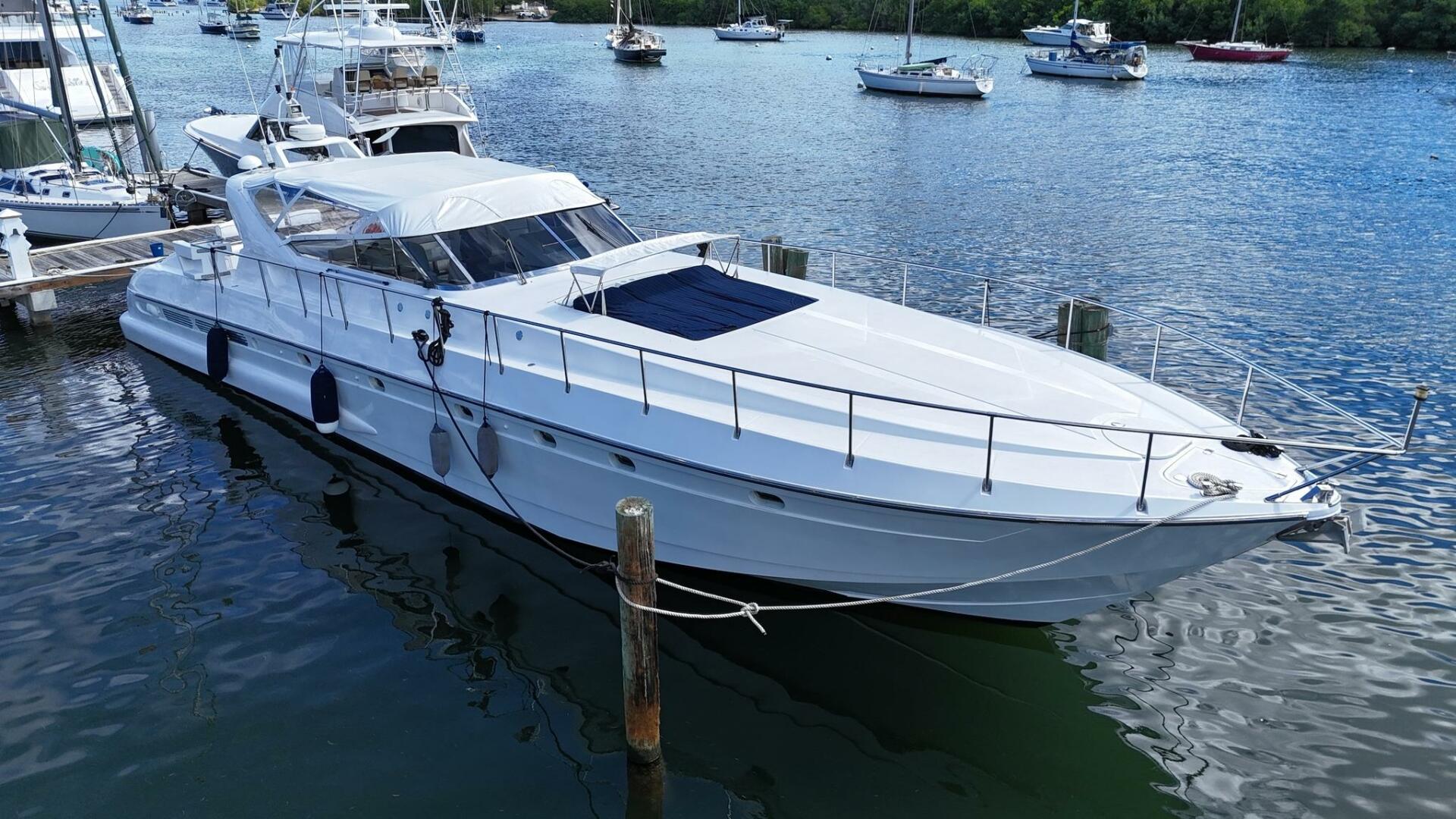
$599,000
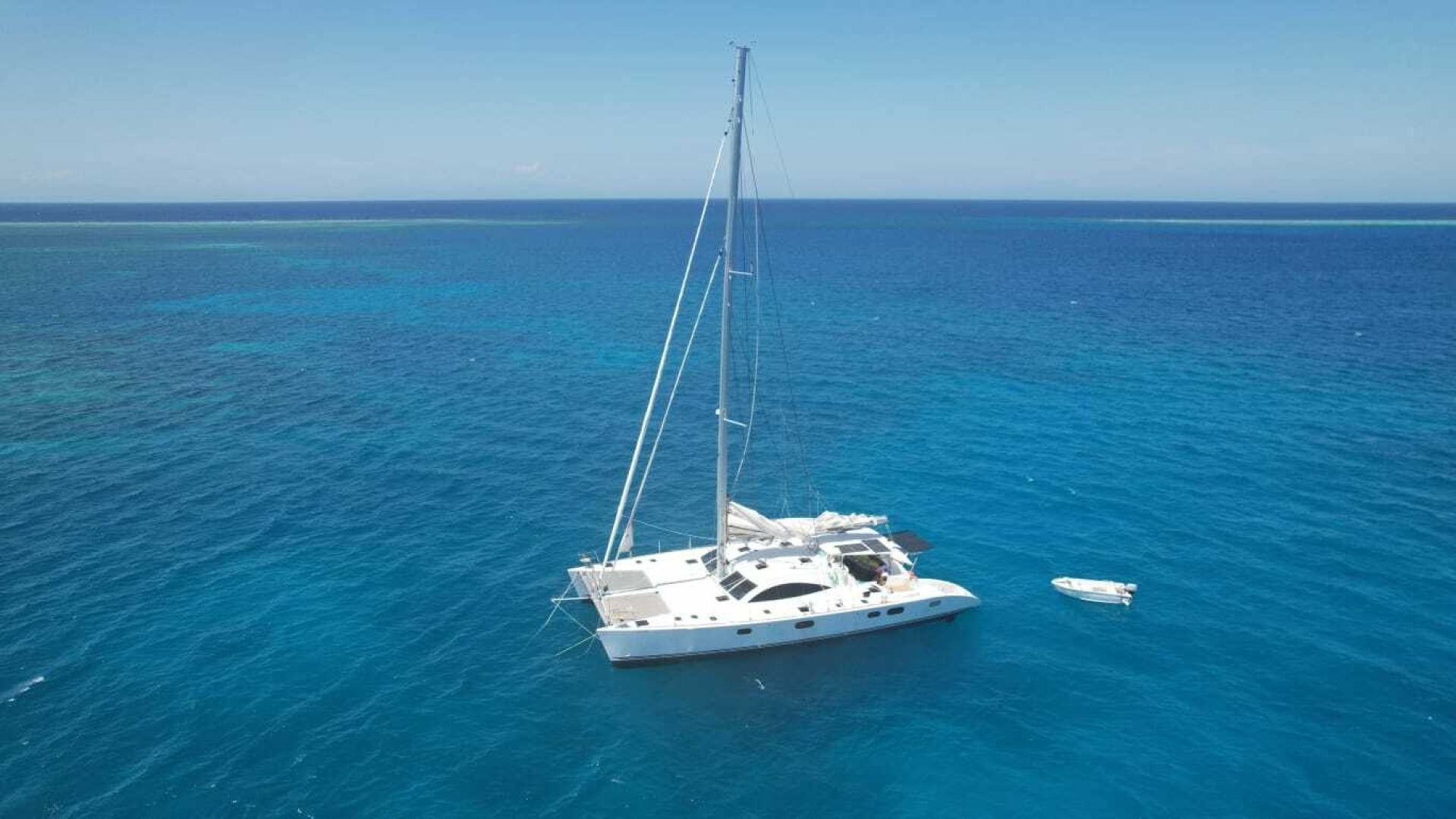
$1,300,000
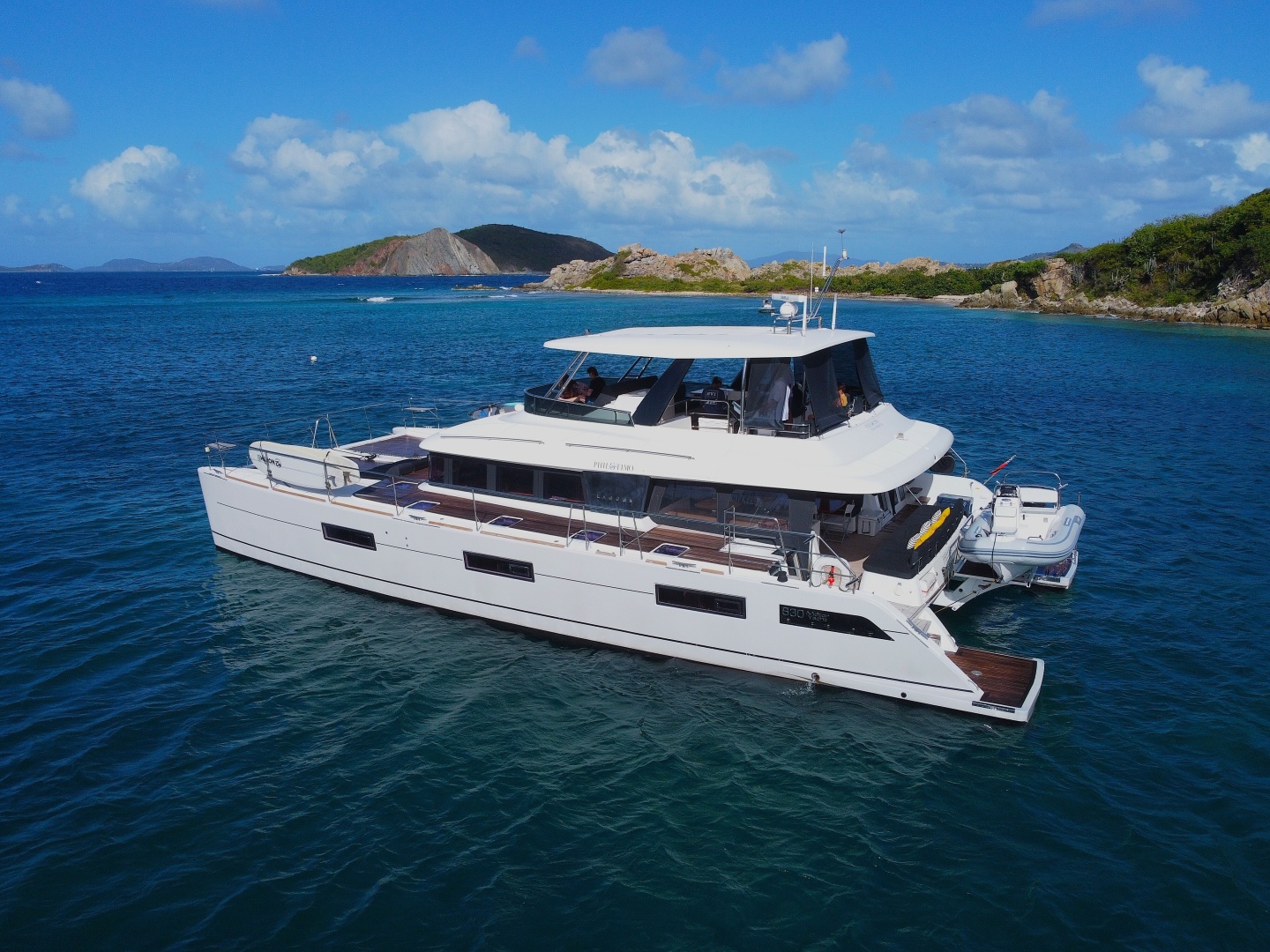
$1,699,000

$299,000

$899,000

$1,795,000

$269,000

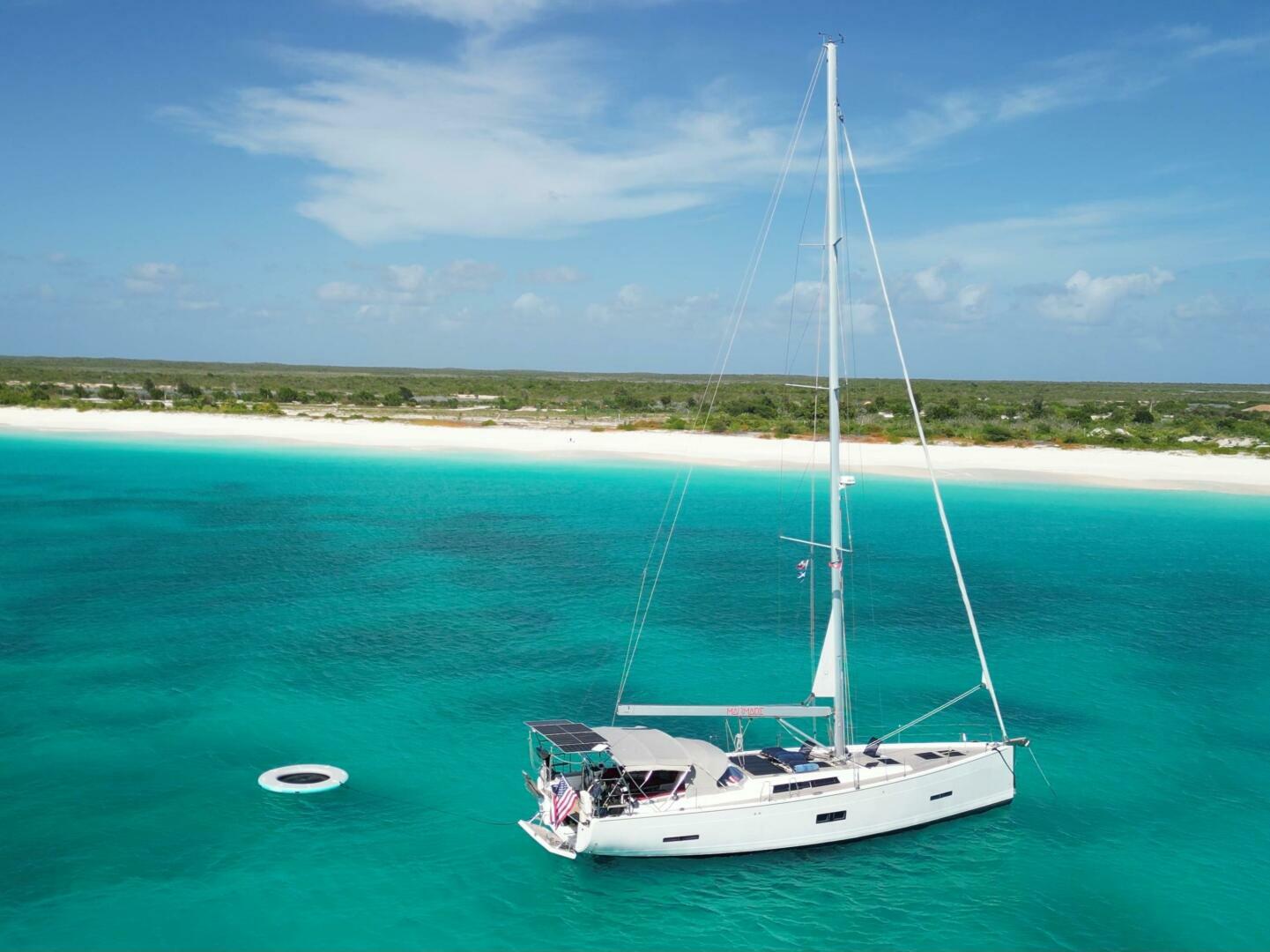
$359,000
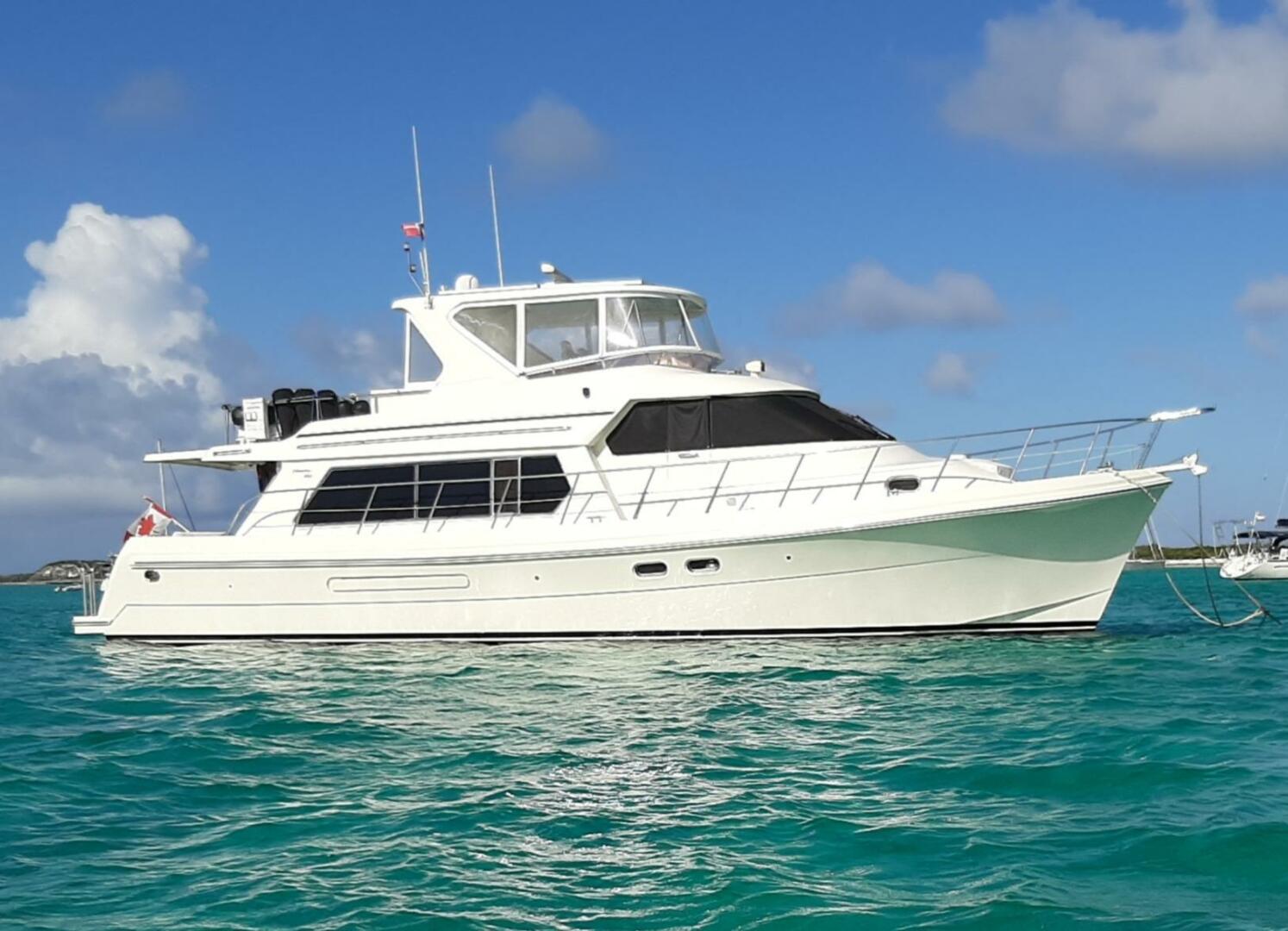
$499,500
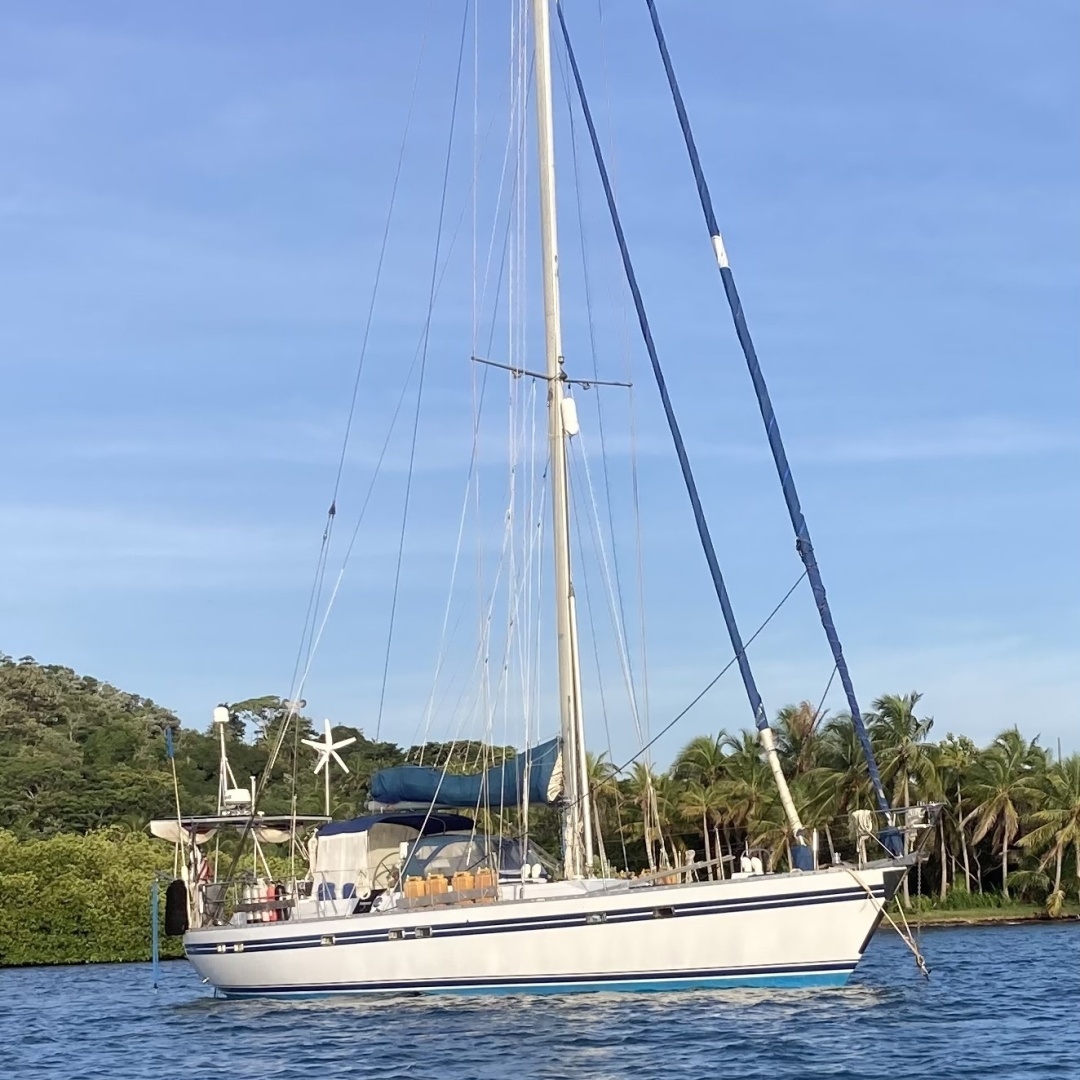
$299,500
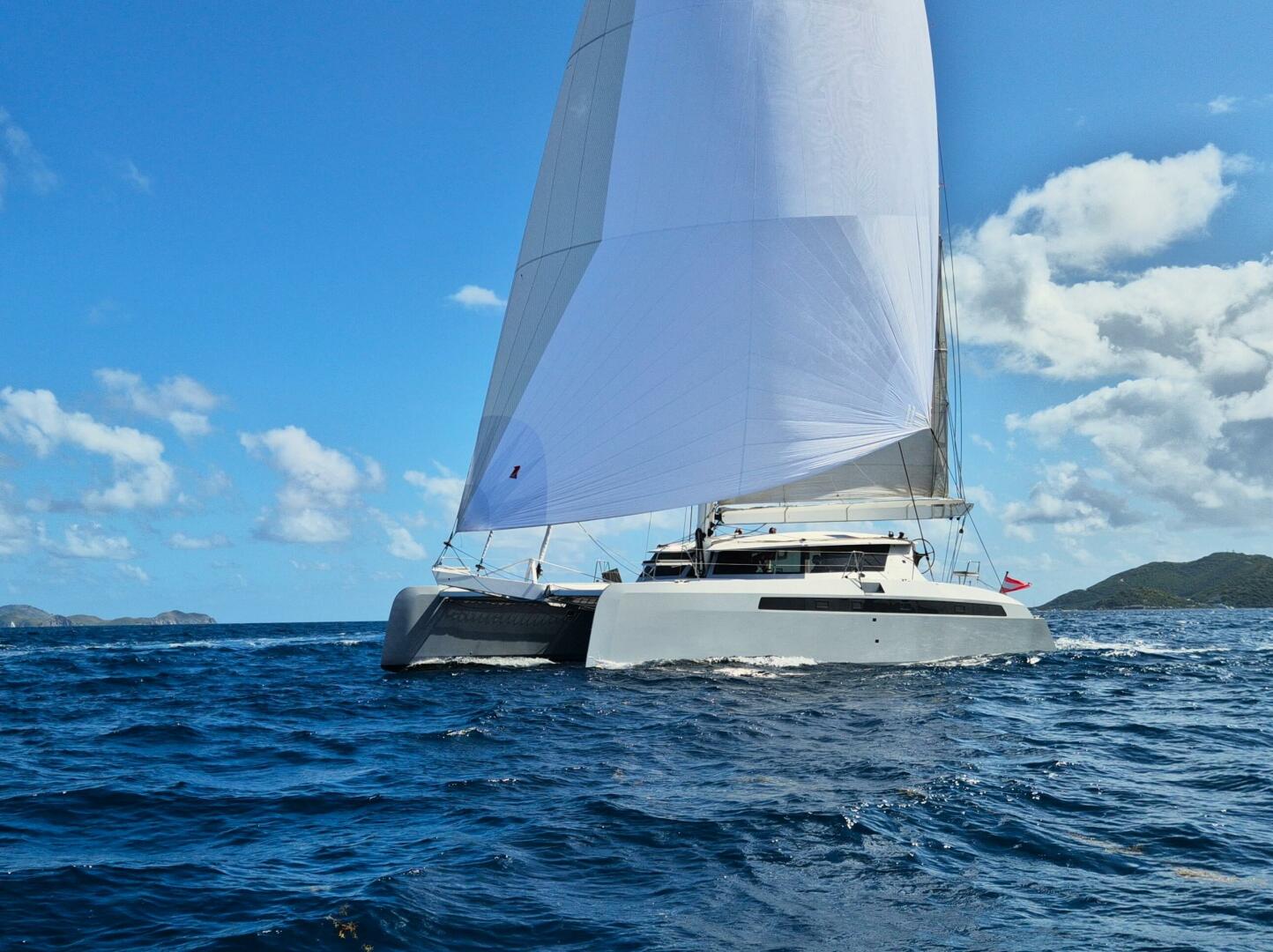
$1,290,000
$800,000
$545,000
$564,900
$1,130,000
$159,000
$499,000
$89,000
$89,000
$135,000
$98,250
$149,850
$369,000
$395,000
$349,000
$125,000
$1,724,571
$149,500
$109,900
$395,000

$652,000
$105,000

$115,000
$950,000
$149,000
$135,000
$349,000